Taxonomic Remarks
Kyphosus species analogus (E. Pacific) and incisor (Atlantic) in Knudsen and Clements, 2013 (Ref. 95491:65) were considered as synonyms of K. vaigiensis.
Umwelt: Milieu / Klimazone / Tiefenbereich / Verbreitungsgebiet
Ökologie
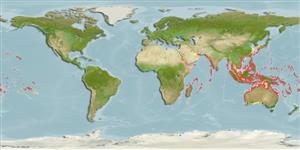
seewasser riff-verbunden; ozeanodrom (Ref. 51243); tiefenbereich 0 - 40 m (Ref. 89972). Tropical; 35°N - 38°S, 25°E - 133°W
Circumtropical: from the eastern Pacific across the Pacific Ocean to the Indian
Ocean, the Red Sea and the eastern and western Atlantic and the Mediterranean.
Länge bei der ersten Reifung / Größe / Gewicht / Alter
Geschlechtsreife: Lm ?, range 39 - ? cm
Max length : 70.0 cm TL Männchen/unbestimmt; (Ref. 559); common length : 50.0 cm TL Männchen/unbestimmt; (Ref. 5450)
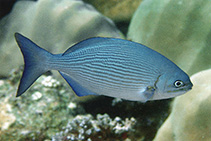
Rückenflossenstacheln (insgesamt) : 10 - 11; Rückenflossenweichstrahlen (insgesamt) : 13 - 15; Afterflossenstacheln: 3; Afterflossenweichstrahlen: 12 - 14; Wirbelzahl: 26. This species is distinguished by the following characters: elongate and oval-shaped body; scale rows horizontally along the body appear alternately golden and bluish; metallic blue dorsally and white ventrally; caudal fin moderately emarginated; very low dorsal and anal fins; D X-XI,13-15; A III, 12-14; pectoral fin 17-20: teeth incisor-shaped; scales on interorbital region; external side of first gill arch with high number of gill rakers on lower limb 16-23, upper limb 5-10; total lateral line scale rows 63-80, 52-63 has pores; longitudinal scale rows 56-70; vertebrae: precaudal 10, caudal 16; pterygiophores, anal 13-14, dorsal 22-24. Colour of body silvery with a bluish shine, with golden horizontal lines along the body (around 23-29), dorsal lines above lateral line curved along the lateral line;; golden streak beneath eye from snout to behind anterior edge of eye; fins are grey or slightly darker grey than body colour (Ref. 95491).
Body shape (shape guide): short and / or deep; Cross section: compressed.
Aggregate over hard, algal coated bottoms of exposed surf-swept outer reef flats, lagoons, and seaward reefs to a depth of at least 24 m. Found in exposed areas around rocky reefs (Ref. 559); adults usually close to the shore and the coastline, while juveniles are associated with flotsam and can be encountered in the open ocean close to the surface (Ref. 95491). Benthopelagic (Ref. 58302). Usually in groups (Ref. 90102). Young (up to 5 cm) found among floating seaweed; feeding on small crustaceans (Ref. 559). Adults are carnivorous during summer and autumn but feed on Endarachne binghamiae during winter (Ref. 559). Good food fish (Ref. 559). Minimum depth reported taken from Ref. 30573.
Lebenszyklus und Paarungsverhalten
Geschlechtsreife | Fortpflanzung | Ablaichen | Eier | Fruchtbarkeit | Larven
Knudsen, S.W. and K.D. Clements, 2013. Revision of the fish family Kyphosidae (Teleostei: Perciformes). Zootaxa 3751(1):001-101. (Ref. 95491)
IUCN Rote Liste Status (Ref. 130435: Version 2025-2 (Global))
Bedrohung für Menschen
Harmless
Nutzung durch Menschen
Fischereien: kommerziell; Sportfisch: ja
Tools
Zusatzinformationen
Download XML
Internet Quellen
Schätzungen auf der Grundlage von Modellen
Bevorzugte Temperatur (Ref.
123201): 24.7 - 29, mean 27.8 °C (based on 896 cells).
Phylogenetischer Diversitätsindex (Ref.
82804): PD
50 = 0.5000 [Uniqueness, from 0.5 = low to 2.0 = high].
Bayesian length-weight: a=0.01820 (0.01138 - 0.02910), b=3.00 (2.86 - 3.14), in cm total length, based on LWR estimates for this species & (Sub)family-body (Ref.
93245).
Trophische Ebene (Ref.
69278): 2.0 ±0.0 se; based on diet studies.
Widerstandsfähigkeit (Ref.
120179): niedrig, Verdopplung der Population dauert 4,5 - 14 Jahre. (Preliminary K or Fecundity.).
Anfälligkeit der Fischerei (Ref.
59153): Moderate to high vulnerability (48 of 100).
🛈
Nährstoffe (Ref.
124155): Calcium = 34 [16, 63] mg/100g; Iron = 0.517 [0.303, 0.890] mg/100g; Protein = 18.2 [16.8, 19.5] %; Omega3 = 0.0772 [, ] g/100g; Selenium = 42 [21, 89] μg/100g; VitaminA = 32.6 [6.9, 140.7] μg/100g; Zinc = 1.24 [0.84, 1.85] mg/100g (wet weight);