>
Cypriniformes (Carps) >
Serpenticobitidae (Snake loaches)
Etymology: Serpenticobitis: Latin, serpens = serpent + see under Cobitis; cingulata: Specific epithet from Latin cingulum (belt or zone) which refers to the belted or banded coloration.
More on author: Roberts.
Entorno: milieu / zona climática / rango de profundidad / gama de distribución
Ecología
; agua dulce demersal. Tropical
Asia: Mekong basin in northern Laos and Thailand.
Tamaño / Peso / Edad
Madurez: Lm ? range ? - ? cm
Max length : 3.9 cm SL macho / no sexado; (Ref. 43281)
Descripción breve
Claves de identificación | Morfología | Morfometría
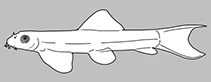
Radios blandos dorsales (total) : 11 - 12; Radios blandos anales: 8; Vértebra: 33 - 35. Morphologically almost identical with S. octozona, but differs strikingly in coloration. Instead of 8-9 thin pale complete bands on a dark background, it has 7-12 thin dark mostly incomplete bands on a pale background. Most of the specimens have only 7-8 incomplete bands; only the 3.77 cm specimen from Huay Huang has 12 bands, many of which go completely around the body (as in S. octozona). Predorsal scales about 40 and transverse scale rows 19/1/14.
Body shape (shape guide): elongated.
Found in muddy streams with fairly swift to very swift flowing water.
Ciclo vital y comportamiento de apareamiento
Madurez | Reproducción | Puesta | Huevos | Fecundidad | Larva
Roberts, T.R., 1997. Serpenticobitis, a new genus of cobitid fishes from the Mekong basin, with two new species. Nat. Hist. Bull. Siam Soc. 45:107-115. (Ref. 38649)
Situación en la Lista Roja de la UICN (Ref. 130435: Version 2025-2 (Global))
Amenaza para el ser humano
Harmless
Usos humanos
Herramientas
Informes especiales
Descargar XML
Fuentes de Internet
Estimaciones basadas en modelos
Índice de diversidad filogenética (Referencia
82804): PD
50 = 0.7500 [Uniqueness, from 0.5 = low to 2.0 = high].
Bayesian length-weight: a=0.00389 (0.00180 - 0.00842), b=3.12 (2.94 - 3.30), in cm total length, based on all LWR estimates for this body shape (Ref.
93245).
Nivel trófico (Referencia
69278): 3.0 ±0.2 se; based on size and trophs of closest relatives
Vulnerabilidad pesquera (Ref.
59153): Low vulnerability (10 of 100).
🛈