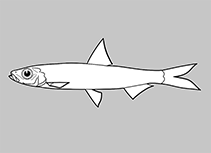
>
Clupeiformes (Herrings) >
Ehiravidae (River sprats)
Etymology: Sundasalanx: Composed from Sunda, Asiatic island + latinization of Philippines, salamga, French salangana = the name of a kind of swallow (Ref. 45335).
More on authors: Britz & Kottelat.
Ambiente: milieu / zona climatica / distribuzione batimetrica / gamma di distribuzione
Ecologia
; acqua dolce demersale. Tropical
Asia: Mekong basin in Laos and Thailand.
Dimensione / Peso / Età
Maturità: Lm ? range ? - ? cm
Max length : 2.8 cm SL maschio/sesso non determinato; (Ref. 38648)
Breve descrizione
Chiavi di identificazione | Morfologia | Morfometria
Raggi dorsali molli (totale) : 12 - 15; Raggi anali molli: 16 - 20; Vertebre: 38 - 42. Differs from all except S. praecox in having vomerine tooth plates (versus missing), more maxillary teeth (30, versus 12-19), 1-3 teeth on caudal end of basibranchial 1-2 in most specimens (versus missing), a completely ringed proximal end of epibranchial 3 surrounding third efferent branchial artery (versus partially encircled), and in lacking in midventral row of melanophores (versus presence). Differs from S. malleti in lacking a basipterygium pigment ring (versus presence). Differs from S. praecox in having several (3-5) prepectoral melanophores (versus missing), more vertebrae (38-42, versus 37-38) and no palatine teeth (versus presence). Differs from all other Sundasalangidae (except S. praecox and S. malleti) in lacking a cardiac chamber pigmentation (versus presence). Also differs from all congeners in having a dermethmoid, supraorbitals, hyomandibulars, autopterotics, exoccipitals, basioccipital and ventral hypohyals (versus these bones not ossified), more gill rakers on branchial arches (10-16 on first arch [versus 2-9], 9-11 on second and third arches, 7-9 anteriorly and 6-8 posteriorly on fourth arch, 6-7 on fifth arch).
Body shape (shape guide): elongated.
Found mostly in large rivers with muddy bottom, turbid water and slow to moderate current. Caught by seine and push net. In all habitats where it was collected by push-net, it was only present at depths greater than 1 meter, usually at a depth immediately below those at which a slight drop in temperature could be felt. Located above the bottom, usually above a layer of 10-20 cm loose ooze.
Ciclo vitale e comportamento di accoppiamento
Maturità | Riproduzione | Deposizione | Uova | Fecondità | Larve
Britz, R. and M. Kottelat, 1999. Sundasalanx mekongensis, a new species of clupeiform fish from the Mekong basin (Teleostei: Sundasalangidae). Ichthyol. Explor. Freshwat. 10(4):337-344. (Ref. 38648)
Stato della Lista Rossa IUCN (Ref. 130435: Version 2025-2 (Global))
Minaccia per l'uomo
Harmless
Usi umani
Strumenti
Rapporti speciali
Scarica XML
Fonti Internet
Stime basate su modelli
Indice di diversità filogenetica (Fonte Biblio.
82804): PD
50 = 0.5078 [Uniqueness, from 0.5 = low to 2.0 = high].
Bayesian length-weight: a=0.00468 (0.00190 - 0.01153), b=3.03 (2.82 - 3.24), in cm total length, based on LWR estimates for this (Sub)family-body shape (Ref.
93245).
Livello trofico (Fonte Biblio.
69278): 3.0 ±0.3 se; based on size and trophs of closest relatives
Vulnerabilità della pesca (Ref.
59153): Low vulnerability (10 of 100).
🛈