Milieu: milieu / Klimaatzone / Diepte / verspreidingsgebied
Ecologie
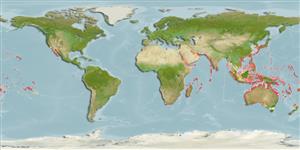
marien rifbewoner; oceanodroom (Ref. 51243); diepte 2 - ? m (Ref. 35942). Tropical; 37°N - 41°S, 17°E - 109°W
Indo-Pacific: Antitropical; Red Sea, South Africa, western and eastern Australia, Lord Howe and Rapa islands, southern Japan and Ryukyu Islands. Records for countries in the tropical zone needs further confirmation.
Lengte bij maturiteit / Grootte / Gewicht / Leeftijd
Maturiteit: Lm 36.0, range 34 - 38 cm
Max length : 75.0 cm TL mannelijk / geslacht onbekend; (Ref. 30573); max. gepubliceerd gewicht: 1.9 kg (Ref. 40637)
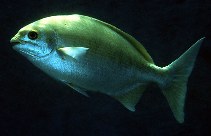
Dorsale stekels (totaal) : 11; Dorsale zachte stralen (totaal) : 11 - 12; Anale stekels: 3; Anale zachte stralen: 10 - 12; Wervels: 16. This species is distinguished by the following characters: terminal mouth is almost in an oblique angle; presence of scales in the interorbital region; D XI,11-12 rays; A III,10-12; gill rakers externally on first arch 4-7 + 13-17; pectoral fin is relatively short, 13.6-21.3 %SL); anal-fin base relatively long (18.1-24.8 %SL; lateral line scales 61-76, with pores 51-60; longitudinal scales 54-67; cheek scales 9-16; vertebrae 10 + 16; low number of pterygiophores, dorsal 20-21 and anal 12. Colour of body variable brownish to silvery with dusky unpaired fins when fresh; soft parts of the dorsal and anal fins appear dusky and have black or darker edges; dark edges on dorsal, anal and caudal fins appear pronounced in more adult individuals, but may also vary from habitat to habitat; cheek and area below eye usually with a white or silvery streak (Ref. 95491).
Body shape (shape guide): short and / or deep; Cross section: compressed.
Found around exposed seaward reefs of isolated high islands such as the northernmost Mariana and Bonin Is. Feeds on Sargassum and Turbinaria algae. Valued as a food fish, but not in Hawaii (Ref. 3921).
Levenscyclus en paargedrag
Maturiteit | Voortplanting | Paaien | Eieren | Fecunditeit | Larven
Knudsen, S.W. and K.D. Clements, 2013. Revision of the fish family Kyphosidae (Teleostei: Perciformes). Zootaxa 3751(1):001-101. (Ref. 95491)
Status op de Rode Lijst van het IUCN (Ref. 130435: Version 2025-2 (Global))
Gevaar voor de mens
Harmless
Gebruik door de mens
Visserij: commercieel; sportvis: ja; Aquarium: Commercieel
Tools
Speciale rapporten
Download XML
Internetbronnen
Schattingen op basis van modellen
Gewenste temperatuur (Ref.
123201): 24.5 - 29.2, mean 28.1 °C (based on 3109 cells).
Fylogenetische diversiteitsindex (Ref.
82804): PD
50 = 0.5000 [Uniqueness, from 0.5 = low to 2.0 = high].
Bayesian length-weight: a=0.01660 (0.00847 - 0.03251), b=2.98 (2.80 - 3.16), in cm total length, based on LWR estimates for this species & (Sub)family-body (Ref.
93245).
Trofisch niveau (Ref.
69278): 2.0 ±0.0 se; based on diet studies.
Weerstandsvermogen (Ref.
120179): laag, minimale populatieverdubbelingstijd 4,5-14 jaar (Preliminary K or Fecundity.).
Kwetsbaarheid van de visserij (Ref.
59153): Moderate to high vulnerability (50 of 100).
🛈
Voedingsstoffen (Ref.
124155): Calcium = 33.2 [15.7, 62.1] mg/100g; Iron = 0.512 [0.296, 0.884] mg/100g; Protein = 18.2 [16.9, 19.5] %; Omega3 = 0.0724 [, ] g/100g; Selenium = 38.6 [18.7, 82.2] μg/100g; VitaminA = 31.9 [6.6, 137.0] μg/100g; Zinc = 1.24 [0.84, 1.86] mg/100g (wet weight);