>
Eupercaria/misc (Various families in series Eupercaria) >
Gerreidae (Mojarras)
Etymology: Gerres: Latin, gerres = a kind of anchovies; cited by Plinius.
More on author: Bloch.
Entorno: milieu / zona climática / rango de profundidad / gama de distribución
Ecología
marino; salobre asociado a arrecife; oceanodromo (Ref. 51243); rango de profundidad 1 - 40 m (Ref. 1602). Tropical; 26°C - 29°C (Ref. 4959); 30°N - 12°S
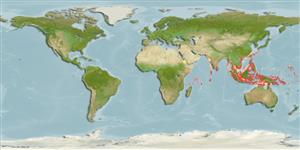
Indo-West Pacific: Madagascar to Australia. Reported from Vanuatu (Ref. 13300). Larvae reported in Japan as Gerres abbreviatus (Ref. 9902).
Tamaño / Peso / Edad
Madurez: Lm ? range ? - ? cm
Max length : 30.0 cm TL macho / no sexado; (Ref. 12915); common length : 25.0 cm SL macho / no sexado; (Ref. 37816)
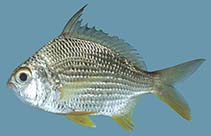
Espinas dorsales (total) : 9; Radios blandos dorsales (total) : 10; Espinas anales: 3; Radios blandos anales: 7. Body silvery with indistinct fine dark stripes along scale rows above and 4-6 rows immediately below lateral line (apparent in newly preserved specimens; larger fishes). Body deep, depth max 1.9-2.3 in SL. Dorsal fin 2nd spine longer than 3rd; anal fin 2nd spine long and robust; caudal fin short and deeply forked; pectoral fins reaches beyond level of anal fin. No scales on upper preopercular flange in approximately 10 cm SL specimens; 1-5 scales (usually 2-3) in over 16 cm SL specimens. Scales between 5th dorsal fin spine base and lateral line 3.5-4.5 (Ref. 28029, 90102). Supraneural bones 3 (Ref. 41102). Ventral and anal fins yellow with white tips Ref. 34765).
Body shape (shape guide): short and / or deep; Cross section: compressed.
Marine species that enters estuaries and coastal lagoons in Madagascar (Ref. 4323). Forms schools on sandy bottoms (Ref. 12915, 48635). Small juveniles feed on zooplankton, larger fish feed on small polychaetes, bivalves, crustaceans and fishes (Ref. 3409). In Palau, spawners migrate from mangroves and sand flats to the outer reef edge around the full moon (Ref. 1602). Marketed fresh or made into fishballs (Ref. 12915).
Ciclo vital y comportamiento de apareamiento
Madurez | Reproducción | Puesta | Huevos | Fecundidad | Larva
Iwatsuki, Y., S. Kimura and T. Yoshino, 1998. Redescription of Gerres erythrourus (Bloch, 1791), a senior synonym of G. abbreviatus Bleeker, 1850 (Teleostei: Perciformes: Gerreidae). Copeia 1998(1):165-172. (Ref. 28029)
Situación en la Lista Roja de la UICN (Ref. 130435: Version 2025-2 (Global))
Amenaza para el ser humano
Harmless
Usos humanos
Pesquerías: escaso valor comercial
Herramientas
Informes especiales
Descargar XML
Fuentes de Internet
Estimaciones basadas en modelos
Temperatura preferida (Referencia
123201): 25.2 - 29.1, mean 28.5 °C (based on 694 cells).
Índice de diversidad filogenética (Referencia
82804): PD
50 = 0.5000 [Uniqueness, from 0.5 = low to 2.0 = high].
Bayesian length-weight: a=0.01202 (0.00897 - 0.01611), b=3.04 (2.99 - 3.09), in cm total length, based on LWR estimates for this species (Ref.
93245).
Nivel trófico (Referencia
69278): 3.3 ±0.43 se; based on food items.
Resiliencia (Referencia
120179): Alto, población duplicada en un tiempo mínimo inferior a 15 meses (Preliminary K or Fecundity.).
Vulnerabilidad pesquera (Ref.
59153): Low vulnerability (20 of 100).
🛈
Nutrientes (Ref.
124155): Calcium = 59.5 [25.4, 105.9] mg/100g; Iron = 0.557 [0.278, 1.092] mg/100g; Protein = 19.1 [17.1, 21.1] %; Omega3 = 0.119 [0.062, 0.210] g/100g; Selenium = 30.7 [15.8, 61.0] μg/100g; VitaminA = 45.3 [10.8, 175.0] μg/100g; Zinc = 1.29 [0.82, 1.91] mg/100g (wet weight);