Environnement : milieu / zone climatique / profondeur / gamme de distribution
Écologie
; eau douce benthopélagique. Subtropical
Asia: known only from the Mekong basin in Yunnan, China.
Taille / Poids / Âge
Maturité: Lm ? range ? - ? cm
Max length : 6.2 cm SL mâle / non sexé; (Ref. 45625)
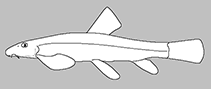
Rayons mous dorsaux (Total) : 11; Rayons mous anaux: 7. Similar to Balitora brucei, but differs from the latter in having a slender body, depth in length 8.9 (8.2-9.3) versus 6.7, more undivided rays in pectoral fins, 10-11 versus 8, and more rays in ventral fins and having a wider head (Ref. 39391).
Body shape (shape guide): eel-like.
Cycle de vie et comportement reproducteur
Maturité | Reproduction | Frai | Œufs | Fécondité | Larves
Chen, Y. and W. Tang, 2000. Homalopteridae: Gastromyzoninae, Homalopterinae. p. 438-567. In P. Yue et al. (Eds). Fauna Sinica. Osteichthyes. Cypriniformes III. Science Press. Beijing. 1-661. (Ref. 45625)
Statut dans la liste rouge de l'IUCN (Ref. 130435: Version 2025-2 (Global))
Menace pour l'homme
Harmless
Utilisations par l'homme
Outils
Articles particuliers
Télécharger en XML
Sources Internet
Estimations basées sur des modèles
Indice de diversité phylogénétique (Réf.
82804): PD
50 = 0.5000 [Uniqueness, from 0.5 = low to 2.0 = high].
Bayesian length-weight: a=0.00214 (0.00085 - 0.00539), b=3.09 (2.87 - 3.31), in cm total length, based on LWR estimates for this (Sub)family-body shape (Ref.
93245).
Niveau trophique (Réf.
69278): 2.5 ±0.2 se; based on size and trophs of closest relatives
Vulnérabilité de la pêche (Ref.
59153): Low vulnerability (10 of 100).
🛈