>
Anguilliformes (Eels and morays) >
Chlopsidae (False morays)
Etymology: Boehlkenchelys: Because of Dr. James Böhlke + Greek, enchelys,-yos = eel (Ref. 45335); longidentata: Named for its long, needle-like teeth.
Eponymy: James Erwin Böhlke (1930–1982) and his wife Eugenia Louisa Böhlke née Brandt (1929–2001) were both ichthyologists who worked at the Academy of Natural Sciences of Philadelphia, where he was Curator of Ichthyology (1954–1982). [...] (Ref. 128868), visit book page.
Environnement : milieu / zone climatique / profondeur / gamme de distribution
Écologie
marin démersal; profondeur 12 - 65 m (Ref. 58018). Tropical
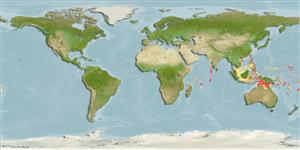
Indo-West Pacific: Chagos. Islands, Indonesia, Fiji, and Palau.
Taille / Poids / Âge
Maturité: Lm ? range ? - ? cm
Max length : 20.1 cm TL mâle / non sexé; (Ref. 37816)
Description synthétique
Clés d'identification | Morphologie | Morphométrie
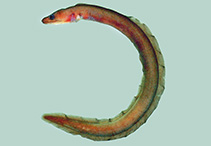
Rayons mous dorsaux (Total) : 340 - 373; Rayons mous anaux: 253 - 294; Vertèbres: 121 - 128. Uniformly olive-brown in life. Body depth 27-31; HL 7.5 - 7.7 (Ref. 37816). Dorsal fin begins above or slightly anterior to the gill opening. Pectoral fin well-developed, rounded, almost twice eye diameter in length. Snout relatively deep. Gape moderate, rictus behind posterior margin of eye. Anterior nostril tubular, slightly behind tip of snout, directed anterolaterally. Posterior nostril a simple elliptical opening in front of middle of eye. Lateral line obsolete except for 2-3 pores in the branchial region (Ref. 40884).
Body shape (shape guide): eel-like; Cross section: compressed.
Inhabits seaward reef slopes.
Cycle de vie et comportement reproducteur
Maturité | Reproduction | Frai | Œufs | Fécondité | Larves
Tighe, K.A., 1992. Boehlkenchelys longidentata, a new genus and species of chlopsid eel (Teleostei: Anguilliformes) from the Indo-West Pacific Region. Proc. Biol. Soc. Wash. 105(1):19-22. (Ref. 40884)
Statut dans la liste rouge de l'IUCN (Ref. 130435: Version 2025-2 (Global))
Menace pour l'homme
Harmless
Utilisations par l'homme
Outils
Articles particuliers
Télécharger en XML
Sources Internet
Estimations basées sur des modèles
Température préférée (Réf.
123201): 26.5 - 28.9, mean 27.8 °C (based on 86 cells).
Indice de diversité phylogénétique (Réf.
82804): PD
50 = 1.0000 [Uniqueness, from 0.5 = low to 2.0 = high].
Bayesian length-weight: a=0.00102 (0.00046 - 0.00225), b=3.06 (2.88 - 3.24), in cm total length, based on all LWR estimates for this body shape (Ref.
93245).
Niveau trophique (Réf.
69278): 3.8 ±0.6 se; based on size and trophs of closest relatives
Vulnérabilité de la pêche (Ref.
59153): Low vulnerability (10 of 100).
🛈