>
Blenniiformes (Blennies) >
Chaenopsidae (Pike-, tube- and flagblennies)
Etymology: Emblemariopsis: Latin, emblema = insertion, inlaid work, raised ornament + Greek, opsis = appearance (Ref. 45335).
Eponymy: George Cadle Price (1919–2011) was the premier of Belize (1961–1984 & 1989–1993). [...] (Ref. 128868), visit book page.
More on author: Greenfield.
Ambiente: milieu / zona climatica / distribuzione batimetrica / gamma di distribuzione
Ecologia
marino associati a barriera corallina; non migratori; distribuzione batimetrica 1 - 30 m (Ref. 51514). Tropical
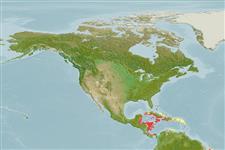
Western Atlantic: Belize and Honduras.
Lunghezza alla prima maturità / Dimensione / Peso / Età
Maturità: Lm 1.8, range 2 - 1.92 cm
Max length : 2.9 cm SL maschio/sesso non determinato; (Ref. 51514); 2.0 cm SL (female)
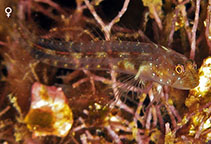
Spine dorsali (totale) : 20; Raggi dorsali molli (totale) : 12 - 14; Spine anali: 2; Raggi anali molli: 21 - 23. This species with no orbital cirrus or a red banner is distinguished by the following characters: TP territorial males found in holes with a black head; the anterior dorsal fin plain black without a white rim, sometimes irregular grainy white patches; the first dorsal-fin spine very short, when adpressed extending posteriorly to about 5th spine base, about 1/4 HL, and subsequent spines rising to midfin spines; sometimes with an irregular row of dark spots along proximal membranes of spinous dorsal fin; occasionally with a short row of small dark spots along anterior lateral midline (Ref. 125603).
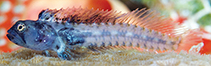
Dark-shaded, pale, and transitional TP with very short first dorsal-fin spine, when adpressed reaching to 4th spine base, subsequent spines rising to midfin; usually large irregular grainy white patches on dorsal fin, anterior body, and pectoral fins; usually with an irregular row of dark spots along proximal spinous-dorsal-fin membranes, often indistinct; sometimes with a short row of small dark spots along anterior lateral midline; opercular bands or lines absent; reduced head markings with a dark band from eye across the jaws, a moustache band at rim above maxilla (from a single spot to a thick curve under eye), and typically with an obvious discrete black spot (or small collection) just behind mid-orbit (Ref. 125603).
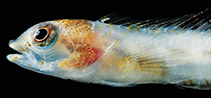
IP with very short first dorsal-fin spines, when adpressed the first spine reaching to base of 4th-5th spine base, spines rising sharply to midfin spines. Colouration: live colors red, orange, and pink; cranial pattern a Y-shape: an oval band 1, band 2 a prominent Y with pale arms and a red stalk, with a reduced band 3 of one or two isolated spots or segments, a long pale band 4 becoming red towards midline, and band 5 inconspicuous; IP head spots are reduced, typically only a band from eye across jaws and a spot at corner of jaw, one under the jaw; melanophores near pectoral-fin base diffuse, sometimes one or two spots (Ref. 125603).
Cross section: oval.
Found on surface of hard corals and sea fans on coral reefs, from shallow reef crests to drop offs at depths to 30 m. Exhibit greater habitat specificity than other chaenopsids. Spirobranchus giganteus. Females and immature males move about on surface of or near live corals, particularly sea fans. Breeding males are particularly found only in tubes abandoned by serpulid worms Spirobranchus giganteus. These probably controls their population size (Ref. 51514).
Females lay eggs in tube cavities occupied by breeding males (Ref. 51514).
Victor, B.C., 2020. Review of the glass blennies (Teleostei: Chaenopsidae: Emblemariopsis) with two new species from the Caribbean Sea. J. Ocean Sci. Found. 37:1-122. (Ref. 125603)
Stato della Lista Rossa IUCN (Ref. 130435: Version 2025-2 (Global))
Minaccia per l'uomo
Harmless
Usi umani
Strumenti
Rapporti speciali
Scarica XML
Fonti Internet
Stime basate su modelli
Temperatura preferita (Fonte Biblio.
123201): 27.3 - 28.3, mean 27.9 °C (based on 139 cells).
Indice di diversità filogenetica (Fonte Biblio.
82804): PD
50 = 0.5001 [Uniqueness, from 0.5 = low to 2.0 = high].
Bayesian length-weight: a=0.00525 (0.00224 - 0.01232), b=3.07 (2.86 - 3.28), in cm total length, based on LWR estimates for this (Sub)family-body shape (Ref.
93245).
Livello trofico (Fonte Biblio.
69278): 3.2 ±0.5 se; based on size and trophs of closest relatives
Resilienza (Fonte Biblio.
120179): Basso, tempo minimo di raddoppiamento della popolazione 4.5 - 14 anni (tm=1; Fec = 21).
Vulnerabilità della pesca (Ref.
59153): Low vulnerability (10 of 100).
🛈