>
Kurtiformes (Nurseryfishes, cardinalfishes.) >
Apogonidae (Cardinalfishes) > Apogoninae
Etymology: Cheilodipterus: Greek, cheilos = lip + Greek, di = two + Greek, pteryx = fin (Ref. 45335).
More on author: Lacepède.
Milieu: milieu / Klimaatzone / Diepte / verspreidingsgebied
Ecologie
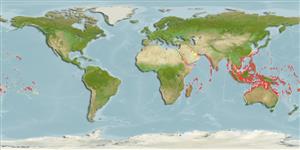
marien rifbewoner; standvastig (Ref. 52884); diepte 0 - 100 m (Ref. 9710), usually ? - 30 m (Ref. 11441). Tropical; 30°N - 35°S, 25°E - 133°W
Indo-Pacific: Red Sea and East Africa (Ref. 8525) to Pitcairn, north to the Ryukyu Islands, south to Lord Howe Island and Rapa.
Grootte / Gewicht / Leeftijd
Maturiteit: Lm ? range ? - ? cm
Max length : 25.0 cm TL mannelijk / geslacht onbekend; (Ref. 11441)
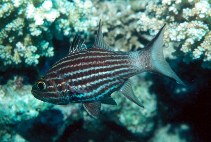
Dorsale stekels (totaal) : 7; Dorsale zachte stralen (totaal) : 9; Anale stekels: 2; Anale zachte stralen: 8. Characterized by having dorsal fin rays VI-I, 9; anal fin rays II,8; pectoral fin rays 12; pelvic fin rays I, 5; pored lateral line scales 25; predorsal scales 6; circumpeduncular scales 12; large canine-like teeth on jaws; preopercular margin serrated (Ref. 93839).; juveniles have a large black blotch on the caudal peduncle which becomes diffuse with age. Adults resemble adults of C. artus, but have wider stripes with darker interspace (Ref. 37816); characterized further by pale grey color; eight red-brown stripes on side, caudal fin base whitish; dark caudal fin margins; greatest depth of body 3.1-3.8 in SL (Ref. 90102).
Body shape (shape guide): short and / or deep; Cross section: compressed.
Common in outer reef slopes in 4-30 m depth; in caves and ledges of clear lagoon and seaward reefs from 0.5 to at least 40 m, generally hovering solitarily in midwater (Ref. 1602). Adults usually in pairs or small groups comprising several pairs; juveniles solitary or small groups (Ref. 48635). Monogamous and always in home-ranging pairs, that is they do not defend an exclusive territory (Ref. 52884). Adults feed primarily on small fishes (Ref. 9710). Sexual maturity reached at about 8 cm. Maximum depth reported taken from Ref. 128797.
Levenscyclus en paargedrag
Maturiteit | Voortplanting | Paaien | Eieren | Fecunditeit | Larven
Mouthbrooders (Ref. 240). Distinct pairing during courtship and spawning (Ref. 205). Displays obligate monogamy where a one-to-one pair is established irrespective of resource abundance (Ref. 52884).
Gon, O., 1993. Revision of the cardinalfish genus Cheilodipterus (Perciformes: Apogonidae), with description of five new species. Indo-Pac. Fish. (22):59 p. (Ref. 8525)
Status op de Rode Lijst van het IUCN (Ref. 130435: Version 2025-2 (Global))
Gevaar voor de mens
Harmless
Gebruik door de mens
Tools
Speciale rapporten
Download XML
Internetbronnen
Schattingen op basis van modellen
Gewenste temperatuur (Ref.
123201): 24.7 - 29, mean 27.8 °C (based on 1114 cells).
Fylogenetische diversiteitsindex (Ref.
82804): PD
50 = 0.5000 [Uniqueness, from 0.5 = low to 2.0 = high].
Bayesian length-weight: a=0.01202 (0.00722 - 0.02002), b=3.17 (3.03 - 3.31), in cm total length, based on LWR estimates for this species & (Sub)family-body (Ref.
93245).
Trofisch niveau (Ref.
69278): 4.1 ±0.61 se; based on food items.
Weerstandsvermogen (Ref.
120179): Gemiddeld, minimale populatieverdubbelingstijd 1,4-4,4 jaar (Preliminary K or Fecundity.).
Kwetsbaarheid van de visserij (Ref.
59153): Low vulnerability (15 of 100).
🛈
Voedingsstoffen (Ref.
124155): Calcium = 66.1 [33.7, 114.0] mg/100g; Iron = 0.638 [0.370, 1.043] mg/100g; Protein = 19 [18, 20] %; Omega3 = 0.124 [0.076, 0.197] g/100g; Selenium = 29.8 [17.0, 56.1] μg/100g; VitaminA = 59.1 [17.9, 189.2] μg/100g; Zinc = 1.02 [0.70, 1.49] mg/100g (wet weight);