Classification / Noms
Noms communs | Synonymes | Catalog of Fishes(Genre, Espèce) | ITIS | CoL | WoRMS | Cloffa
>
Siluriformes (Catfishes) >
Trichomycteridae (Pencil or parasitic catfishes) > Trichomycterinae
Etymology: Trichomycterus: Greek, thrix = hair + Greek, mykter, -eros = nose (Ref. 45335).
More on authors: Fernández & Vari.
Environnement : milieu / zone climatique / profondeur / gamme de distribution
Écologie
; eau douce benthopélagique. High altitude; 26°S - 27°S
South America: Laguna Blanca basin in Catamarca, Argentina.
Taille / Poids / Âge
Maturité: Lm ? range ? - ? cm
Max length : 4.2 cm mâle / non sexé; (Ref. 39970)
Description synthétique
Clés d'identification | Morphologie | Morphométrie
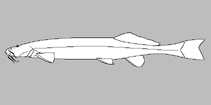
Épines dorsales (Total) : 0; Rayons mous dorsaux (Total) : 12 - 13; Épines anales: 0; Rayons mous anaux: 11 - 12; Vertèbres: 37 - 39. Eye covered by thin, transparent skin. Species differs from all other known members of the subfamily Trichomycterinae by the combination of its lack of both the pelvic fins and girdle, eight or nine principle dorsal fin rays, 37-39 vertebrae, 18-20 ribs on each side, the elongate body with a transversely flattened caudal peduncle, the posteriorly straight and slightly posterodorsally angled caudal fin margin, the lack of pronounced marmorated pigmentation on the body and fins, its lack of s very thick, rugose layer of fatty tissue on the body and head, the presence of a portion of the laterosensory canal system within the sphenotic, the lack of an extensive perforation of the skin surface by pores of the ampullary organs, and its maximum length.
Body shape (shape guide): elongated; Cross section: circular.
Collected from a 0.5 m deep, small, clear water stream with a sandy bottom at an elevation of approximately 3500 m. The stomachs of two specimens contained dipteran larvae (Chironomidae and Ceratopogonidae), filamentous algae, and sand indicating that the species feeds, at least in part on autochthonous benthic macroinvertebrates (Ref. 37038).
Cycle de vie et comportement reproducteur
Maturité | Reproduction | Frai | Œufs | Fécondité | Larves
Fernández, L. and R.P. Vari, 2000. New species of Trichomycterus (Teleostei: Siluriformes: Trichomycteridae) lacking a pelvic fin and girdle from the Andes of Argentina. Copeia 2000(4):990-996. (Ref. 37038)
Statut dans la liste rouge de l'IUCN (Ref. 130435: Version 2025-2 (Global))
Menace pour l'homme
Harmless
Utilisations par l'homme
Pêcheries: sans intérêt
Outils
Articles particuliers
Télécharger en XML
Sources Internet
Estimations basées sur des modèles
Indice de diversité phylogénétique (Réf.
82804): PD
50 = 0.5000 [Uniqueness, from 0.5 = low to 2.0 = high].
Bayesian length-weight: a=0.00912 (0.00396 - 0.02102), b=2.97 (2.79 - 3.15), in cm total length, based on LWR estimates for this Genus-body shape (Ref.
93245).
Niveau trophique (Réf.
69278): 2.8 ±0.31 se; based on food items.
Résilience (Réf.
120179): Faible, temps minimum de doublement de population : 4,5 à 14 années (Assuming Fec < 100).
Vulnérabilité de la pêche (Ref.
59153): Low vulnerability (10 of 100).
🛈