>
Cypriniformes (Carps) >
Nemacheilidae (Brook loaches)
Etymology: Schistura: Greek, schizein = to divide + Greek, oura = tail; an allusion to forked caudal fins (Ref. 45335); coruscans: From the Latin corusco (to flame, to flash).
More on author: Kottelat.
Environnement : milieu / zone climatique / profondeur / gamme de distribution
Écologie
; eau douce benthopélagique. Tropical
Asia: Nam San basin, a tributary of Nam Ngum of the Mekong basin in Laos.
Taille / Poids / Âge
Maturité: Lm ? range ? - ? cm
Max length : 6.6 cm SL mâle / non sexé; (Ref. 43281)
Description synthétique
Clés d'identification | Morphologie | Morphométrie
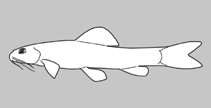
Snout profile arched; anterior nostril pierced on front side of a flap; processus dentiformis present; a small median notch in upper lip, lower lip with a median incision; head length 22.0-24.1 %SL; body depth 17.8-19.7 %SL; caudal peduncle length 16.5-18.8 %SL, depth 13.4-14.8 %SL, 1.16-1.33 times in length; lateral line complete; anus about 1-2 eye diameters in front of anal-fin origin; 8.5 branched dorsal-fin rays; 5.5 branched anal-fin rays; caudal fin emarginate, with 9+8 branched rays; axillary pelvic lobe present; top of head marmorated, no particular pattern; body with 7-13 bars, usually wider than or as wide as interspaces, wider anteriorly than posteriorly; black bar at caudal-fin base usually complete but very faint, except for a vertically elongate blotch occupying about half of caudal-fin base; dorsal-fin base with a black spot at anterior extremity, sometimes an elongate blotch further behind; in life, bright red dorsal and caudal fins, bright yellow-orange anal, pelvic and pectoral fins (Ref. 36949). Juveniles (2 cm SL) with irregular bars, often appearing as pairs of black bars with paler grey area in between (Ref. 43281).
Body shape (shape guide): elongated.
Found in riffles, among stones (Ref. 36949).
Cycle de vie et comportement reproducteur
Maturité | Reproduction | Frai | Œufs | Fécondité | Larves
Kottelat, M., 2001. Fishes of Laos. WHT Publications Ltd., Colombo 5, Sri Lanka. 198 p. (Ref. 43281)
Statut dans la liste rouge de l'IUCN (Ref. 130435: Version 2025-2 (Global))
Menace pour l'homme
Harmless
Utilisations par l'homme
Outils
Articles particuliers
Télécharger en XML
Sources Internet
Estimations basées sur des modèles
Indice de diversité phylogénétique (Réf.
82804): PD
50 = 0.5000 [Uniqueness, from 0.5 = low to 2.0 = high].
Bayesian length-weight: a=0.00708 (0.00323 - 0.01553), b=3.03 (2.86 - 3.20), in cm total length, based on LWR estimates for this Genus-body shape (Ref.
93245).
Niveau trophique (Réf.
69278): 3.0 ±0.3 se; based on size and trophs of closest relatives
Résilience (Réf.
120179): Milieu, temps minimum de doublement de population : 1,4 à 4,4 années (Preliminary K or Fecundity.).
Vulnérabilité de la pêche (Ref.
59153): Low vulnerability (10 of 100).
🛈