>
Cypriniformes (Carps) >
Nemacheilidae (Brook loaches)
Etymology: Schistura: Greek, schizein = to divide + Greek, oura = tail; an allusion to forked caudal fins (Ref. 45335); amplizona: From the Latin amplus (broad) and zona (belt).
More on author: Kottelat.
Environnement : milieu / zone climatique / profondeur / gamme de distribution
Écologie
; eau douce benthopélagique. Tropical
Asia: Mekong in Nam Tha and Nam Youan basins in northern Laos; Luosuojiang River subbasin in Yunnan, China.
Taille / Poids / Âge
Maturité: Lm ? range ? - ? cm
Max length : 9.1 cm SL mâle / non sexé; (Ref. 36949)
Description synthétique
Clés d'identification | Morphologie | Morphométrie
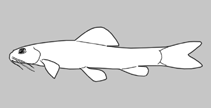
Anterior nostril pierced on front side of a flap; processus dentiformis present; lower lip interrupted medially; lateral line complete; anus about 1-2 eye diameters in front of anal-fin origin; 8.5 branched dorsal-fin rays; 5.5 branched anal-fin rays; caudal fin emarginate, with 9+8 branched rays; axillary pelvic lobe present; body yellowish with a broad very faint grey midlateral stripe; 5-7 broad blackish brown bars on body, wider than interspaces, wider anteriorly than posteriorly, usually wider on lateral line than on back; black bar at caudal-fin base slightly oblique, restricted to lower two-thirds; a black spot at the base of upper principal rays; dorsal fin with a long black blotch, along base of branched rays only; series of marks on rays of all fins; head slender; no notch in lower jaw; caudal peduncle with hard dorsal and ventral keels on posterior half, 1.42-1.69 times longer than deep (Ref. 36949).
Body shape (shape guide): elongated.
Cycle de vie et comportement reproducteur
Maturité | Reproduction | Frai | Œufs | Fécondité | Larves
Kottelat, M., 2000. Diagnosis of a new genus and 64 new species of fishes from Laos (Teleostei: Cyprinidae, Balitoridae, Bagridae, Syngnathidae, Chaudhuriidae and Tetraodontidae). J. South Asian Nat. Hist. 5(1):37-82. (Ref. 36949)
Statut dans la liste rouge de l'IUCN (Ref. 130435: Version 2025-2 (Global))
Menace pour l'homme
Harmless
Utilisations par l'homme
Outils
Articles particuliers
Télécharger en XML
Sources Internet
Estimations basées sur des modèles
Indice de diversité phylogénétique (Réf.
82804): PD
50 = 0.5000 [Uniqueness, from 0.5 = low to 2.0 = high].
Bayesian length-weight: a=0.00708 (0.00323 - 0.01553), b=3.03 (2.86 - 3.20), in cm total length, based on LWR estimates for this Genus-body shape (Ref.
93245).
Niveau trophique (Réf.
69278): 3.0 ±0.3 se; based on size and trophs of closest relatives
Résilience (Réf.
120179): Milieu, temps minimum de doublement de population : 1,4 à 4,4 années (Preliminary K or Fecundity.).
Vulnérabilité de la pêche (Ref.
59153): Low vulnerability (10 of 100).
🛈