>
Clupeiformes (Herrings) >
Engraulidae (Anchovies) > Engraulinae
Etymology: Stolephorus: Greek, stole, -es = garment + Greek, pherein = to carry (Ref. 45335).
More on author: Bleeker.
Miljö: miljö / Klimatzon / djupintervall / distributionsområde
Ekologi
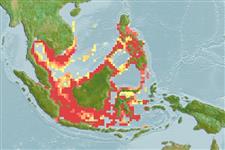
marina; brackvatten pelagic-neritic; amfidrom (Ref. 51243); djupintervall 0 - 50 m (Ref. 189). Tropical; 17°N - 11°S, 98°E - 127°E (Ref. 189)
Western Pacific: Gulf of Thailand and Java Sea. Indian Ocean records probably based on Stolephorus baganensis or Stolephorus insularis.
Storlek / Vikt / Ålder
Könsmognad: Lm ? range ? - ? cm
Max length : 9.5 cm SL hane/ej könsbestämd; (Ref. 189)
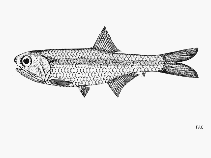
Taggstrålar i ryggfenan (totalt) : 0; Taggstrålar i analfenan: 0; Mjukstrålar i analfenan: 17 - 18. Belly with 6 or 7 small needle-like pre-pelvic scutes; a small pre-dorsal spine and another spine on the pelvic scute. Maxilla pointed, reaching to or beyond hind border of pre-operculum, the latter concave, indented near maxilla tip. Anal fin short, with origin below about middle of dorsal fin base. A double pigment line on back both before and behind dorsal fin.
Body shape (shape guide): elongated; Cross section: compressed.
A schooling species found in coastal waters. Adults frequently visit the lower reaches of mangroves where neritic conditions are present (Ref. 43081). More specimens and data needed.
Livscykel och parningsbeteende
Könsmognad | Reproduktion | Lek | Ägg | Fekunditet | Larver
Wongratana, T., T.A. Munroe and M. Nizinski, 1999. Order Clupeiformes. Engraulidae. Anchovies. p. 1698-1753. In K.E. Carpenter and V.H. Niem (eds.) FAO species identification guide for fishery purposes. The living marine resources of the WCP. Vol. 3. Batoid fishes, chimaeras and bony fishes part 1 (Elopidae to Linophrynidae). FAO, Rome. (Ref. 9822)
Status på IUCN:s rödlista (Ref. 130435: Version 2025-2 (Global))
Hot mot människor
Harmless
Mänskliga användningsområden
Fiskeri: kommersiell
Verktyg
Särskilda rapporter
Ladda ner XML
Internet-källor
Uppskattningar baserade på modeller
Önskad temperatur (Ref.
123201): 28.2 - 29.1, mean 28.8 °C (based on 302 cells).
Index för fylogenetisk mångfald (Ref.
82804): PD
50 = 0.5000 [Uniqueness, from 0.5 = low to 2.0 = high].
Bayesian length-weight: a=0.00562 (0.00276 - 0.01147), b=3.14 (2.97 - 3.31), in cm total length, based on LWR estimates for this species & Genus-body shape (Ref.
93245).
Trofisk nivå (Ref.
69278): 3.3 ±0.4 se; based on size and trophs of closest relatives
Resiliens (Ref.
120179): Hög, lägsta populationsfördubblingstid mindre än 15 månader (K>1).
Sårbarhet i fisket (Ref.
59153): Low vulnerability (10 of 100).
🛈
Näringsämnen (Ref.
124155): Calcium = 472 [141, 1,252] mg/100g; Iron = 2.49 [1.36, 4.42] mg/100g; Protein = 19.3 [17.5, 21.2] %; Omega3 = 0.478 [0.207, 1.122] g/100g; Selenium = 45.4 [19.8, 97.1] μg/100g; VitaminA = 38.5 [8.5, 162.7] μg/100g; Zinc = 2.68 [1.74, 3.99] mg/100g (wet weight); based on
nutrient studies.