Elasmobranchii (tubarões e raias) (sharks and rays) >
Myliobatiformes (Stingrays) >
Dasyatidae (Stingrays) > Dasyatinae
Etymology: marianae: Named for Mariana R. Oliveria, daughter of Otto B.F. Gadig.
Eponymy: Mariana Ramos de Oliveira Gadig is the daughter of Otto Gadig, the third author. She works as a microbiologist at Prefeitura Municipal de Santos, Brazil. She is also a psychologist in private practice. [Sketch modified on the request of M. Ramos herself]. (Ref. 128868), visit book page.
Ambiente: milieu / zona climática / intervalo de profundidade / gama de distribuição
Ecologia
marinhas demersal; intervalo de profundidade 2 - 15 m (Ref. 36974). Tropical; 0°S - 19°S, 38°W - 45°W (Ref. 36974)
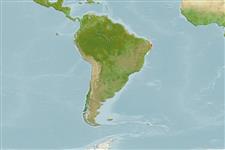
Southwest Atlantic: along the northeastern Brazilian coast, from the state of Maranhão to southern Bahia.
Tamanho / Peso / Idade
Maturidade: Lm ? range ? - ? cm
Max length : 40.0 cm WD macho/indeterminado; (Ref. 36974)
Descrição breve
Chaves de identificação | Morfologia | Morfometria
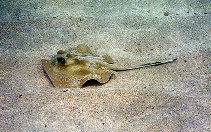
This medium-sized species of Dasyatis is distinguished by the following characters: horizontal diameter of eye nearly equal to interorbital width and spiracle length; its tail is relatively short, less than two times disk width, distally filiform, with dorsal and ventral finfolds, ending approximately on same vertical line; height of dorsal finfold 1.5-2 in height of ventral finfold; the dorsal surface of disc is yellowish brown, with dark blotch between spiracles and two pairs of dark scapular and precaudal blotches; margins of disc and pelvic fins are blue dorsally; the ventral surface of disc white, with two symmetrical pairs of dark markings in adults (Ref. 36974).
Body shape (shape guide): other; Cross section: flattened.
Apparently associated with coral or sandstone reefs of the northeastern Brazilian continental shelf. Two female specimens were collected from the stomach of Rachycentron canadum (Ref. 36974). Juveniles also occurred in sandy beaches and estuaries. Ovoviviparous (Ref. 50449).
Ciclo de vida e comportamento de acasalamento
Maturidade | Reprodução | Desova | Ovos | Fecundidade | Larvas
Exhibit ovoviparity (aplacental viviparity), with embryos feeding initially on yolk, then receiving additional nourishment from the mother by indirect absorption of uterine fluid enriched with mucus, fat or protein through specialised structures (Ref. 50449). Distinct pairing with embrace (Ref. 205). A gravid female aborted one fully formed embryo (Ref. 36974).
Gomes, U.L., R.S. Rosa and O.B.F. Gadig, 2000. Dasyatis marianae sp. n.: a new species of stingray (Chondrichthyes: Dasyatidae) from the southwestern Atlantic. Copeia 2000(2):510-515. (Ref. 36974)
Categoria na Lista Vermelha da IUCN (Ref. 130435: Version 2025-2 (Global))
Ameaça para o homem
Harmless
Utilização humana
Ferramentas
Relatórios especiais
Descarregue XML
Fontes da internet
Estimativas baseadas em modelos
Temperatura preferida (Ref.
123201): 27 - 27.9, mean 27.4 °C (based on 44 cells).
Índice de diversidade filogenética (Ref.
82804): PD
50 = 0.5010 [Uniqueness, from 0.5 = low to 2.0 = high].
Bayesian length-weight: a=0.01023 (0.00626 - 0.01674), b=3.15 (3.02 - 3.28), in cm total length, based on LWR estimates for this species & (Sub)family-body (Ref.
93245).
Nível Trófico (Ref.
69278): 3.5 ±0.5 se; based on size and trophs of closest relatives
Resiliência (Ref.
120179): Muito baixo, tempo mínimo de duplicação da população maior que 14 anos (Fec=2).
Vulnerabilidade da pesca (Ref.
59153): Very high vulnerability (90 of 100).
🛈