>
Acanthuriformes (Surgeonfishes) >
Lobotidae (Tripletails)
Etymology: Hapalogenys: Greek, hapalos = soft * Greek, geny, -yos = face (Ref. 45335); merguiensis: Named for its type locality, Mergui Basin, southern Myanmar Sea.
Ambiente: milieu / zona climatica / distribuzione batimetrica / gamma di distribuzione
Ecologia
marino pelagic-neritic; distribuzione batimetrica 78 - 180 m (Ref. 36944). Tropical
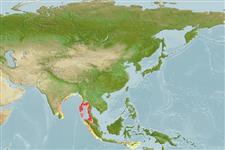
Eastern Indian Ocean: known only from the Andaman Sea, off southern Myanmar, including Mergui Basin and Taninthayi Coast, and off Phuket, west coast of Thailand. Possibly occurring in the Andaman and Nicobar islands, Bay of Bengal and Straits of Malacca.
Dimensione / Peso / Età
Maturità: Lm ? range ? - ? cm
Max length : 17.9 cm SL maschio/sesso non determinato; (Ref. 36944); 24.2 cm SL (female)
Breve descrizione
Chiavi di identificazione | Morfologia | Morfometria
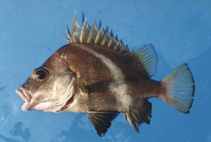
Spine dorsali (totale) : 6; Raggi dorsali molli (totale) : 14; Spine anali: 3; Raggi anali molli: 9 - 10; Vertebre: 24. Head and body generally dark brownish when fresh. Two indistinct oblique dark bands on body, the first descending from the nape to behind the pectoral fin; the second from base of anterior 2nd or 3rd dorsal fin spines and soft dorsal fin base, curving backward thru the lateral line to soft anal fin and caudal peduncle. Maxillary scales absent. Eye diameter greater than one quarter of the head length. Ten pores on and behind the chin; often with slitlike pores posteriorly. Fleshy lower lip with a cluster of very short dense papillae. At the origin of the dorsal fin is a procumbent spinelike process (exposed tip of first pterygiophore) (Ref. 36944).
Body shape (shape guide): short and / or deep; Cross section: compressed.
Occurs over rocky bottom.
Ciclo vitale e comportamento di accoppiamento
Maturità | Riproduzione | Deposizione | Uova | Fecondità | Larve
Iwatsuki, Y., U. Satapoomin and K. Amaoka, 2000. New species: Hapalogenys merguiensis (Teleostei; Perciformes) from Andaman Sea. Copeia 2000(1):129-139. (Ref. 36944)
Stato della Lista Rossa IUCN (Ref. 130435: Version 2025-2 (Global))
Usi umani
Strumenti
Rapporti speciali
Scarica XML
Fonti Internet
Stime basate su modelli
Temperatura preferita (Fonte Biblio.
123201): 17.6 - 23.2, mean 21.7 °C (based on 14 cells).
Indice di diversità filogenetica (Fonte Biblio.
82804): PD
50 = 0.5039 [Uniqueness, from 0.5 = low to 2.0 = high].
Bayesian length-weight: a=0.01905 (0.00861 - 0.04217), b=3.01 (2.81 - 3.21), in cm total length, based on LWR estimates for this (Sub)family-body shape (Ref.
93245).
Livello trofico (Fonte Biblio.
69278): 3.9 ±0.6 se; based on size and trophs of closest relatives
Resilienza (Fonte Biblio.
120179): Alto, tempo minimo di raddoppiamento della popolazione meno di 15 mesi (Preliminary K or Fecundity.).
Vulnerabilità della pesca (Ref.
59153): Low vulnerability (20 of 100).
🛈