Classification / Noms
Noms communs | Synonymes | Catalog of Fishes(Genre, Espèce) | ITIS | CoL | WoRMS | Cloffa
>
Siluriformes (Catfishes) >
Heptapteridae (Three-barbeled catfishes)
Etymology: Nemuroglanis: From the Nemuro peninsula in Japan, Hokkaido + Greek, glanis = a fish that can eat the bait without touching the hook; a cat fish.
Environnement : milieu / zone climatique / profondeur / gamme de distribution
Écologie
; eau douce démersal. Tropical
South America: Orinoco, Negro and Sanabani River basins.
Taille / Poids / Âge
Maturité: Lm ? range ? - ? cm
Max length : 3.3 cm SL mâle / non sexé; (Ref. 55662)
Description synthétique
Clés d'identification | Morphologie | Morphométrie
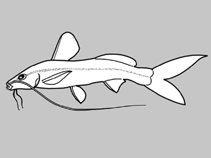
Rayons mous anaux: 10 - 11; Vertèbres: 38 - 40. Having the following autapomorphic characters: postcleithral process expanded; suborbital tubule 3 and respective i5 branch and pore of infraorbital latero-sensory canal absent. Shares with Nemuroglanis lanceolatus the following eight apomorphies: five or six pairs of pleural ribs; dorsal caudal plate supports only six principal caudal-fin rays; ventral caudal plate much smaller than dorsal caudal plate, supporting only three or four rays; dorsal caudal-fin lobe with five or fewer branched rays; dorsal caudal-fin lobe very long, usually greater than 40% SL; ventral caudal-fin lobe usually with nine to 13 rays; ventral caudal-fin lobe with only three or four branched rays; and caudal fin lanceolate. Differ further from its congeners by possessing fewer vertebrae, 38-40 and fewer anal-fin rays, 10-11; maxillary barbel length , 38.8-55.8% SL; and anal-fin base length, 13.9-16.2% SL (Ref. 55662).
Cycle de vie et comportement reproducteur
Maturité | Reproduction | Frai | Œufs | Fécondité | Larves
Bockmann, F.A. and C.J. Ferraris Jr., 2005. Systematics of the Neotropical catfish genera Nemuroglanis Eigenmann and Eigenmann 1889, Imparales Schultz 1944, and Medemichthys Dahl 1961 (Siluriformes: Heptapteridae). Copeia 2005(1):124-137. (Ref. 55662)
Statut dans la liste rouge de l'IUCN (Ref. 130435: Version 2025-2 (Global))
Menace pour l'homme
Harmless
Utilisations par l'homme
Outils
Articles particuliers
Télécharger en XML
Sources Internet
Estimations basées sur des modèles
Indice de diversité phylogénétique (Réf.
82804): PD
50 = 0.5312 [Uniqueness, from 0.5 = low to 2.0 = high].
Bayesian length-weight: a=0.00813 (0.00379 - 0.01743), b=2.97 (2.79 - 3.15), in cm total length, based on LWR estimates for this (Sub)family-body shape (Ref.
93245).
Niveau trophique (Réf.
69278): 3.2 ±0.4 se; based on size and trophs of closest relatives
Vulnérabilité de la pêche (Ref.
59153): Low vulnerability (10 of 100).
🛈