>
Tetraodontiformes (Puffers and filefishes) >
Monacanthidae (Filefishes)
Etymology: Paramonacanthus: Greek, para = the side of + Greek, monos = one + Greek, akantha ) thorn (Ref. 45335).
Ambiente: milieu / zona climatica / distribuzione batimetrica / gamma di distribuzione
Ecologia
marino demersale; distribuzione batimetrica 10 - 50 m (Ref. 90102). Tropical
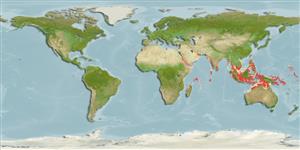
Indian Ocean: both sides of India, and across to the western coast of Thailand. A small post-pelagic juvenile has been collected from the Maldives.
Dimensione / Peso / Età
Maturità: Lm ? range ? - ? cm
Max length : 10.0 cm SL maschio/sesso non determinato; (Ref. 48637)
Breve descrizione
Chiavi di identificazione | Morfologia | Morfometria
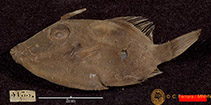
Spine dorsali (totale) : 2; Raggi dorsali molli (totale) : 26 - 29; Spine anali: 0; Raggi anali molli: 27 - 30; Vertebre: 19. Body width 1.9-2.5 in head length; body depth 2.0-2.8 in SL; head length 2.6-3.0 in SL; snout length 3.7-4.3 in SL; eye diameter 2.7-3.8 in head length. Head and body pale, with three wide, darker but rather indistinct stripes on body, first from eye to anterior half of soft dorsal base, second from above gill opening, continuing posteriorly to rear half of soft dorsal base, and third curving up from ventral flap, extending along midside of body to caudal peduncle; two prominent dark blotches separated by a pale wedge-shaped bar below anterior portion of soft dorsal fin; caudal fin with dusky basal blotch, followed by two dark curved cross bands.
Body shape (shape guide): short and / or deep; Cross section: compressed.
Inhabits muddy substrates in estuaries and usually found near algae rubble reef (Ref. 48637). Also found in sand bottoms of trawling grounds in 10-50 m (Ref. 90102).
Ciclo vitale e comportamento di accoppiamento
Maturità | Riproduzione | Deposizione | Uova | Fecondità | Larve
Hutchins, J.B., 1997. Review of the monacanthid fish genus Paramonacanthus, with descriptions of three new species. Rec. West. Aust. Mus. Suppl. No. 54:1-57. (Ref. 33065)
Stato della Lista Rossa IUCN (Ref. 130435: Version 2025-2 (Global))
Minaccia per l'uomo
Harmless
Usi umani
Strumenti
Rapporti speciali
Scarica XML
Fonti Internet
Stime basate su modelli
Temperatura preferita (Fonte Biblio.
123201): 27.5 - 29.2, mean 28.6 °C (based on 576 cells).
Indice di diversità filogenetica (Fonte Biblio.
82804): PD
50 = 0.5000 [Uniqueness, from 0.5 = low to 2.0 = high].
Bayesian length-weight: a=0.01905 (0.00905 - 0.04012), b=2.93 (2.75 - 3.11), in cm total length, based on LWR estimates for this (Sub)family-body shape (Ref.
93245).
Livello trofico (Fonte Biblio.
69278): 3.1 ±0.3 se; based on size and trophs of closest relatives
Resilienza (Fonte Biblio.
120179): Alto, tempo minimo di raddoppiamento della popolazione meno di 15 mesi (Preliminary K or Fecundity.).
Vulnerabilità della pesca (Ref.
59153): Low vulnerability (10 of 100).
🛈