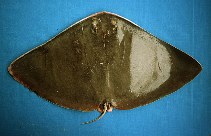
Elasmobranchii (tubarões e raias) (sharks and rays) >
Myliobatiformes (Stingrays) >
Gymnuridae (Butterfly rays)
Etymology: Gymnura: Greek, gymnos = naked + Greek, oura = tail (Ref. 45335).
Eponymy: Not an eponym but a toponym; from the type locality – Lobos de Afuera Island, Peru. (Ref. 128868), visit book page.
More on author: Hildebrand.
Meio ambiente: milieu / Zona climática / intervalo de profundidade / faixa de distribuição
Ecologia
marinhas demersal. Tropical
Southeast Pacific: off Peru.
Tamanho / Peso / Idade
Maturidade: Lm ? range ? - ? cm
Ovoviviparous (Ref. 50449).
Ciclo de vida ou comportamento de acasalamento
Maturidade | Reprodução | Desova | Ovos | Fecundidade | Larvas
Exhibit ovoviparity (aplacental viviparity), with embryos feeding initially on yolk, then receiving additional nourishment from the mother by indirect absorption of uterine fluid enriched with mucus, fat or protein through specialised structures (Ref. 50449). Distinct pairing with embrace (Ref. 205).
Compagno, L.J.V., 1999. Checklist of living elasmobranchs. p. 471-498. In W.C. Hamlett (ed.) Sharks, skates, and rays: the biology of elasmobranch fishes. Johns Hopkins University Press, Maryland. (Ref. 35766)
Status na Lista Vermelha da UICN (Ref. 130435: Version 2025-2 (Global))
Ameaça para os humanos
Harmless
Uso pelos humanos
Ferramentas
Relatórios especiais
Baixar XML
Fontes da internet
Estimativas baseadas em modelos
Índice de diversidade filogenética (Ref.
82804): PD
50 = 0.5000 [Uniqueness, from 0.5 = low to 2.0 = high].
Bayesian length-weight: a=0.00851 (0.00393 - 0.01841), b=3.08 (2.88 - 3.28), in cm total length, based on LWR estimates for this (Sub)family-body shape (Ref.
93245).
Nível Trófico (Ref.
69278): 3.8 ±0.6 se; based on size and trophs of closest relatives
Resiliência (Ref.
120179): Muito baixo(a), tempo mínimo de duplicação da população maior que 14 anos (Fec assumed to be <10).
Vulnerabilidade da pesca (Ref.
59153): Moderate vulnerability (43 of 100).
🛈