Taxonomic Remarks
References and information for southern Australia are retained (including common names). All other references from different study areas are questionable or refer to another species of Sphyraena.
Ambiente: milieu / zona climatica / distribuzione batimetrica / gamma di distribuzione
Ecologia
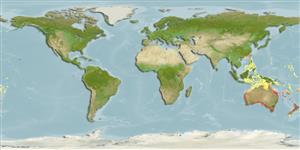
marino pelagic-neritic. Temperate; 32°S - 46°S, 113°E - 155°E (Ref. 123366)
Indo-Pacific: southern coast of Australia.
Dimensione / Peso / Età
Maturità: Lm ? range ? - ? cm
Max length : 100.0 cm TL maschio/sesso non determinato; (Ref. 9563)
Breve descrizione
Chiavi di identificazione | Morfologia | Morfometria
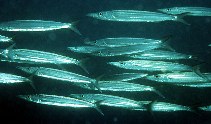
Spine dorsali (totale) : 6; Raggi dorsali molli (totale) : 9; Spine anali: 2; Raggi anali molli: 8. This species is distinguished by the following set of characters: first gill arch with one gill raker; pelvic-fin insertion is located slightly before vertical through first dorsal-fin origin; pored lateral-line scales 120-138 (modally 127), total lateral-line scales 129-146 (134); scales above lateral line 9-11 (10) and below, 11-13 (12); snout is comparatively short, its length 12.2-14.0 (mean 13.2) % SL; upper jaw short, with posterior tip not reaching to below anterior nostril, its length 9.2-10.7 (10.0) % SL; eye small, orbit diameter 3.4-4.5 (4.0) % SL and depth, 3.3-4.2 (3.7) % SL; anal-fin base long, its length 7.6-9.2 (8.5) % SL; last dorsal- and anal-fin ray lengths are 3.6-4.5 (4.0) % SL and 3.3-4.3 (3.9) % SL, respectively; anus is comparatively close to anal-fin origin, its anterior and posterior margins to anal-fin origin 5.8-8.0 (6.9) % HL and 3.1-5.1 (4.0) % HL, respectively; the head sensory canal pores on suborbital area are finely branched, their lowermost parts very close to lacrimal bone margin, large smooth area lacking canal pores absent on mid-margin of lacrimal bone. Colouration: lateral body surface without stripes and bands and caudal fin yellowish-gray (Ref. 123366).
Cross section: compressed.
Occurs in channels and other semi-protected areas. Found in schools. Feeds on various small fish (Ref. 2156).
Ciclo vitale e comportamento di accoppiamento
Maturità | Riproduzione | Deposizione | Uova | Fecondità | Larve
Morishita, S. and H. Motomura, 2020. Sphyraena stellata, a new barracuda from the Indo-Pacific, with redescriptions of S. helleri Jenkins, 1901 and S. novaehollandiae Günther, 1860 (Perciformes: Sphyraenidae). Zootaxa 4772(3):545-566. (Ref. 123366)
Stato della Lista Rossa IUCN (Ref. 130435: Version 2025-2 (Global))
Minaccia per l'uomo
Harmless
Usi umani
Pesca: commerciale; Pesce da pesca sportiva: si
Strumenti
Rapporti speciali
Scarica XML
Fonti Internet
Stime basate su modelli
Temperatura preferita (Fonte Biblio.
123201): 15 - 25.4, mean 18.2 °C (based on 222 cells).
Indice di diversità filogenetica (Fonte Biblio.
82804): PD
50 = 0.5000 [Uniqueness, from 0.5 = low to 2.0 = high].
Bayesian length-weight: a=0.00813 (0.00495 - 0.01335), b=2.81 (2.67 - 2.95), in cm total length, based on LWR estimates for this species & Genus-body shape (Ref.
93245).
Livello trofico (Fonte Biblio.
69278): 4.5 ±0.80 se; based on food items.
Resilienza (Fonte Biblio.
120179): Basso, tempo minimo di raddoppiamento della popolazione 4.5 - 14 anni (Preliminary K or Fecundity.).
Vulnerabilità della pesca (Ref.
59153): High vulnerability (60 of 100).
🛈
Nutrienti (Ref.
124155): Calcium = 26.8 [10.9, 73.4] mg/100g; Iron = 0.596 [0.263, 1.314] mg/100g; Protein = 20.5 [18.4, 22.2] %; Omega3 = 0.227 [0.101, 0.520] g/100g; Selenium = 21.7 [9.2, 55.9] μg/100g; VitaminA = 8.08 [1.49, 47.81] μg/100g; Zinc = 0.322 [0.198, 0.560] mg/100g (wet weight);