Environnement : milieu / zone climatique / profondeur / gamme de distribution
Écologie
marin récifal; non migrateur; profondeur 1 - 40 m (Ref. 90102). Tropical; 30°N - 30°S
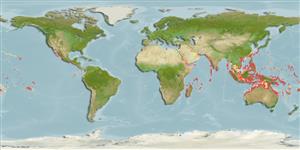
Indo-West Pacific: Red Sea and East Africa to Samoa, north to southern Japan, south to Western Australia and New South Wales, including Lord Howe Island (Ref. 1602).
Taille / Poids / Âge
Maturité: Lm ? range ? - ? cm
Max length : 40.0 cm SL mâle / non sexé; (Ref. 30573)
Épines dorsales (Total) : 13; Rayons mous dorsaux (Total) : 20 - 23; Épines anales: 3; Rayons mous anaux: 18 - 22.
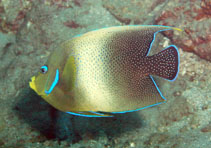
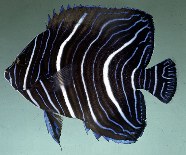
Body shape (shape guide): short and / or deep; Cross section: compressed.
Juveniles inhabit shallow protected areas, while adults prefer coastal reefs with heavy coral growth providing ample hiding places. Generally solitary or in pairs. Feeds on sponges, tunicates, and algae (Ref. 30573). The young are excellent aquarium fish and suitable for a community tank.
Cycle de vie et comportement reproducteur
Maturité | Reproduction | Frai | Œufs | Fécondité | Larves
Myers, R.F., 1991. Micronesian reef fishes. Second Ed. Coral Graphics, Barrigada, Guam. 298 p. (Ref. 1602)
Statut dans la liste rouge de l'IUCN (Ref. 130435: Version 2025-2 (Global))
Menace pour l'homme
Harmless
Utilisations par l'homme
Pêcheries: intérêt commercial mineur; Aquarium: Commercial
Outils
Articles particuliers
Télécharger en XML
Sources Internet
Estimations basées sur des modèles
Température préférée (Réf.
123201): 24.7 - 29, mean 27.8 °C (based on 828 cells).
Indice de diversité phylogénétique (Réf.
82804): PD
50 = 0.5001 [Uniqueness, from 0.5 = low to 2.0 = high].
Bayesian length-weight: a=0.02754 (0.01107 - 0.06854), b=2.89 (2.70 - 3.08), in cm total length, based on LWR estimates for this Genus-body shape (Ref.
93245).
Niveau trophique (Réf.
69278): 2.7 ±0.00 se; based on food items.
Résilience (Réf.
120179): Faible, temps minimum de doublement de population : 4,5 à 14 années (Preliminary K or Fecundity.).
Vulnérabilité de la pêche (Ref.
59153): Moderate vulnerability (39 of 100).
🛈
Nutriments (Ref.
124155): Calcium = 40.4 [19.8, 68.8] mg/100g; Iron = 0.504 [0.299, 0.837] mg/100g; Protein = 18.2 [16.9, 19.4] %; Omega3 = 0.0889 [, ] g/100g; Selenium = 33.3 [17.3, 64.1] μg/100g; VitaminA = 62.3 [15.0, 242.0] μg/100g; Zinc = 1.34 [0.92, 1.93] mg/100g (wet weight);