Taxonomic Remarks
Genetic data indicate that it is a complex of species having apparently similar distribution ranges in the Indo-Pacific (Ref. 114224).
Ambiente: milieu / zona climatica / distribuzione batimetrica / gamma di distribuzione
Ecologia
marino; acqua dolce; salmastro associati a barriera corallina; catadromo (Ref. 46888); distribuzione batimetrica 0 - 3 m (Ref. 86942). Tropical; 35°N - 32°S, 28°E - 135°W
Indo-Pacific: Red Sea, south to Transkei, South Africa (Ref. 4393) and east to the Hawaiian and Marquesan islands, north to southern Japan, south to New Caledonia and Norfolk Island (Ref. 8879) and Tuamotu Islands (Ref. 90102).
Dimensione / Peso / Età
Maturità: Lm ? range ? - ? cm
Max length : 60.0 cm TL maschio/sesso non determinato; (Ref. 9710); common length : 40.0 cm TL maschio/sesso non determinato; (Ref. 5450); peso massimo pubblicato: 8.0 kg (Ref. 37816)
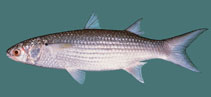
Spine dorsali (totale) : 5; Raggi dorsali molli (totale) : 8 - 9; Spine anali: 3; Raggi anali molli: 9. Diagnosis: Characterized by having membranous, digitate posterior margin on scales; snout shorter than eye diameter; slender maxilla and weakly curved ventrally at posterior tip, partially or completely concealed; poorly developed adipose eyelid as rim around eye; preorbital weakly concave on anteroventral edge (Ref. 90102).
Body shape (shape guide): fusiform / normal; Cross section: oval.
Found in coastal waters but enters estuaries and rivers where they feed on microalgae, filamentous algae, forams, diatoms, and detritus associated with sand and mud (Ref. 9812). Form schools. Oviparous, eggs are pelagic and non-adhesive (Ref. 205). Also caught using stakenets, barrier nets, and pouch nets during spawning; also taken as bycatch (Ref. 9812). Marketed fresh and perhaps salted, boiled (Thailand), canned or frozen (Australia); roe salted (Ref. 9812).
Ciclo vitale e comportamento di accoppiamento
Maturità | Riproduzione | Deposizione | Uova | Fecondità | Larve
Myers, R.F., 1991. Micronesian reef fishes. Second Ed. Coral Graphics, Barrigada, Guam. 298 p. (Ref. 1602)
Stato della Lista Rossa IUCN (Ref. 130435: Version 2025-2 (Global))
Minaccia per l'uomo
Harmless
Usi umani
Pesca: commerciale
Strumenti
Rapporti speciali
Scarica XML
Fonti Internet
Stime basate su modelli
Temperatura preferita (Fonte Biblio.
123201): 25.2 - 29.3, mean 28.5 °C (based on 3155 cells).
Indice di diversità filogenetica (Fonte Biblio.
82804): PD
50 = 0.5156 [Uniqueness, from 0.5 = low to 2.0 = high].
Bayesian length-weight: a=0.01202 (0.01056 - 0.01369), b=2.96 (2.93 - 2.99), in cm total length, based on LWR estimates for this species (Ref.
93245).
Livello trofico (Fonte Biblio.
69278): 2.3 ±0.14 se; based on food items.
Generation time: 4.8 ( na - na) years. Estimated as median ln(3)/K based on 2
growth studies.
Resilienza (Fonte Biblio.
120179): Medio, tempo minimo di raddoppiamento della popolazione 1.4 - 4.4 anni (K=0.23-0.28).
Prior r = 0.35, 95% CL = 0.23 - 0.53, Based on 2 data-limited stock assessments.
Vulnerabilità della pesca (Ref.
59153): Moderate vulnerability (40 of 100).
🛈
Vulnerabilità climatica (Ref.
125649): Very high vulnerability (82 of 100).
🛈
Nutrienti (Ref.
124155): Calcium = 53.4 [20.9, 168.7] mg/100g; Iron = 0.614 [0.274, 1.463] mg/100g; Protein = 19.1 [17.2, 20.9] %; Omega3 = 0.145 [0.069, 0.311] g/100g; Selenium = 21.9 [11.0, 49.6] μg/100g; VitaminA = 53.2 [11.9, 234.3] μg/100g; Zinc = 1.74 [1.10, 2.70] mg/100g (wet weight); based on
nutrient studies.