>
Eupercaria/misc (Various families in series Eupercaria) >
Labridae (Wrasses) > Julidinae
Etymology: Thalassoma: Greek, thalassa = the sea + Greek, soma = body; the colour of the sea (Ref. 45335).
More on authors: Lay & Bennett.
Ambiente: milieu / zona climatica / distribuzione batimetrica / gamma di distribuzione
Ecologia
marino associati a barriera corallina; distribuzione batimetrica 0 - 40 m (Ref. 2334), usually 1 - 5 m (Ref. 90102). Tropical; 30°N - 32°S
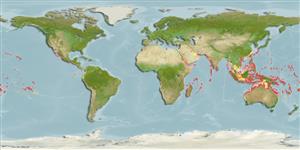
Indo-Pacific: East Africa to the Hawaiian, Marquesan, and Tuamoto islands, north to the Ryukyu Islands. Replaced by Thalassoma cupido from southern Japan to Taiwan, Thalassoma heiseri in Pitcairn, and Thalassoma loxum at Oman (Ref. 37816). Reported hybrids with Thalassoma jansenii in Banda Sea, Indonesia and with Thalassoma nigrofasciatum in Holmes Reef, Coral Sea (Ref. 57554).
Dimensione / Peso / Età
Maturità: Lm ? range ? - ? cm
Max length : 17.0 cm TL maschio/sesso non determinato; (Ref. 4392)
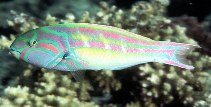
Spine dorsali (totale) : 8; Raggi dorsali molli (totale) : 12 - 14; Spine anali: 3; Raggi anali molli: 10 - 12. Males display with brilliant colors, red lines turning purple and often the abdomen bright yellow (Ref. 48636). Two uneven red stripes on dorsal half of body, 1 from below dorsal-fin origin onto upper caudal lobe, the other from above pectoral-fin base to caudal peduncle. Pectoral fins with green base and dark pectoral fins (Ref 9823).
Body shape (shape guide): fusiform / normal; Cross section: compressed.
Found in clear outer lagoon reefs (Ref. 9710) and exposed seaward reefs. Abundant in shallow exposed areas with surge channels (Ref. 9710, 48636), with gutters, large Acropora plates and algae bottom (Ref. 48636). Benthopelagic (Ref. 58302). Males are often in small loose numbers, swimming over reef sections where small groups of females stay close to the bottom. Juveniles secretive in shallow gutters (Ref. 48636). Feed mainly on benthic crustaceans (crabs, shrimps), small fishes, gastropod mollusks, and sea urchins.
Ciclo vitale e comportamento di accoppiamento
Maturità | Riproduzione | Deposizione | Uova | Fecondità | Larve
Pelagic spawner.
Randall, J.E., G.R. Allen and R.C. Steene, 1990. Fishes of the Great Barrier Reef and Coral Sea. University of Hawaii Press, Honolulu, Hawaii. 506 p. (Ref. 2334)
Stato della Lista Rossa IUCN (Ref. 130435: Version 2025-2 (Global))
Minaccia per l'uomo
Harmless
Usi umani
Pesca: commerciale; Acquario: Commerciale
Strumenti
Rapporti speciali
Scarica XML
Fonti Internet
Stime basate su modelli
Temperatura preferita (Fonte Biblio.
123201): 25 - 29.3, mean 28.3 °C (based on 2873 cells).
Indice di diversità filogenetica (Fonte Biblio.
82804): PD
50 = 0.5000 [Uniqueness, from 0.5 = low to 2.0 = high].
Bayesian length-weight: a=0.01000 (0.00446 - 0.02243), b=3.05 (2.88 - 3.22), in cm total length, based on LWR estimates for this Genus-body shape (Ref.
93245).
Livello trofico (Fonte Biblio.
69278): 3.6 ±0.56 se; based on food items.
Resilienza (Fonte Biblio.
120179): Alto, tempo minimo di raddoppiamento della popolazione meno di 15 mesi (Preliminary K or Fecundity.).
Vulnerabilità della pesca (Ref.
59153): Low vulnerability (10 of 100).
🛈
Nutrienti (Ref.
124155): Calcium = 77.5 [46.8, 130.8] mg/100g; Iron = 0.69 [0.41, 1.26] mg/100g; Protein = 18.5 [15.7, 20.7] %; Omega3 = 0.161 [0.105, 0.250] g/100g; Selenium = 25 [15, 44] μg/100g; VitaminA = 140 [44, 517] μg/100g; Zinc = 1.59 [1.10, 2.46] mg/100g (wet weight);