>
Eupercaria/misc (Various families in series Eupercaria) >
Labridae (Wrasses) > Julidinae
Etymology: Thalassoma: Greek, thalassa = the sea + Greek, soma = body; the colour of the sea (Ref. 45335).
More on author: Forsskål.
Umwelt: Milieu / Klimazone / Tiefenbereich / Verbreitungsgebiet
Ökologie
seewasser riff-verbunden; tiefenbereich 0 - 10 m (Ref. 30573). Tropical; 32°N - 32°S
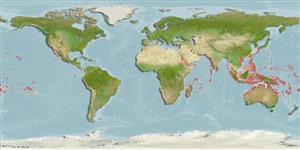
Southeast Atlantic: southeast coast of South Africa. Indo-Pacific: East to Red Sea to the Hawaiian, Marquesan, and Easter islands, north to southern Japan, south to Lord Howe, Kermadec, and Rapa islands (Ref. 4392). Replaced by Thalassoma virens in the Revillagigedo Archipelago (Ref. 37816).
Größe / Gewicht / Alter
Geschlechtsreife: Lm ? range ? - ? cm
Max length : 46.0 cm TL Männchen/unbestimmt; (Ref. 30573); max. veröff. Gewicht: 1.2 kg (Ref. 40637)
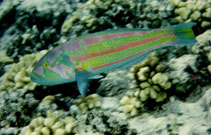
Rückenflossenstacheln (insgesamt) : 8; Rückenflossenweichstrahlen (insgesamt) : 12 - 14; Afterflossenstacheln: 3; Afterflossenweichstrahlen: 10 - 12. T. purpureum and T. trilobatum have nearly identical initial phases (Ref. 1602). They differ slightly in details of the head markings, and T. purpureum has a slightly longer head, shorter pectoral fins, and attains a larger size (Ref. 1602, 48636). Females best distinguished by the 'V' mark on the snout (Ref. 48636). Initial phase with a vertical dark red line below front of eye usually with a branch to front of snout (Ref 9823).
Body shape (shape guide): fusiform / normal; Cross section: compressed.
Found almost exclusively in the surge zone of outer reef flats, reef margins, and rocky coastlines, down to a depth of about 10 m (Ref. 5213). Benthopelagic (Ref. 58302). Occur in groups of females that are spread out over large reef sections and dominated by few males. Males grow much larger than females (Ref. 48636). Feed on small invertebrates (crabs, sea urchins, brittlestars, mollusks), small fishes, echinoids, ophiuroids and polychaetes (Ref. 37816). Protogynous (Ref. 55080).
Lebenszyklus und Paarungsverhalten
Geschlechtsreife | Fortpflanzung | Ablaichen | Eier | Fruchtbarkeit | Larven
Pelagic spawner.
Randall, J.E., G.R. Allen and R.C. Steene, 1990. Fishes of the Great Barrier Reef and Coral Sea. University of Hawaii Press, Honolulu, Hawaii. 506 p. (Ref. 2334)
IUCN Rote Liste Status (Ref. 130435: Version 2025-2 (Global))
Bedrohung für Menschen
Harmless
Nutzung durch Menschen
Fischereien: weniger kommerziell; Sportfisch: ja; Aquarium: Kommerziell
Tools
Zusatzinformationen
Download XML
Internet Quellen
Schätzungen auf der Grundlage von Modellen
Bevorzugte Temperatur (Ref.
123201): 24.6 - 29.3, mean 28.3 °C (based on 3134 cells).
Phylogenetischer Diversitätsindex (Ref.
82804): PD
50 = 0.5000 [Uniqueness, from 0.5 = low to 2.0 = high].
Bayesian length-weight: a=0.01000 (0.00446 - 0.02243), b=3.05 (2.88 - 3.22), in cm total length, based on LWR estimates for this Genus-body shape (Ref.
93245).
Trophische Ebene (Ref.
69278): 3.8 ±0.0 se; based on diet studies.
Widerstandsfähigkeit (Ref.
120179): mittel, Verdopplung der Population dauert 1,4 - 4,4 Jahre. (Preliminary K or Fecundity.).
Anfälligkeit der Fischerei (Ref.
59153): Moderate vulnerability (36 of 100).
🛈
Nährstoffe (Ref.
124155): Calcium = 42.4 [25.2, 69.5] mg/100g; Iron = 0.532 [0.303, 0.984] mg/100g; Protein = 18.8 [15.9, 21.1] %; Omega3 = 0.118 [0.076, 0.185] g/100g; Selenium = 23.1 [13.7, 42.7] μg/100g; VitaminA = 105 [31, 372] μg/100g; Zinc = 1.25 [0.88, 1.92] mg/100g (wet weight);