>
Eupercaria/misc (Various families in series Eupercaria) >
Labridae (Wrasses) > Julidinae
Etymology: Thalassoma: Greek, thalassa = the sea + Greek, soma = body; the colour of the sea (Ref. 45335).
More on author: Linnaeus.
Περιβάλλον: περιβάλλον / κλιματική ζώνη / εύρος βάθους / εύρος διανομής
Οικολογία
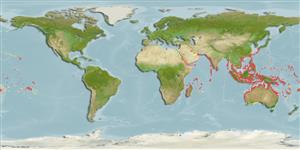
Θαλασσινό(ά) Υφαλόφιλο(α); εύρος βάθους 1 - 20 m (Ref. 9823), usually 1 - 20 m (Ref. 27115). Subtropical; 24°C - 28°C (Ref. 27115); 32°N - 36°S, 24°E - 136°W
Indo-Pacific: Red Sea and East Africa (Ref. 4392) to the Line Islands, north to southern Japan, south to Lord Howe Island and northern New Zealand (Ref. 1602). Reported to have formed a hybrid with Thalassoma rueppellii (Ref. 41655).
Μέγεθος / Βάρος / Ηλικία
Γεννητική Ωρίμανση: Lm ? range ? - ? cm
Max length : 45.0 cm TL αρσενικό/απροσδιόριστο; (Ref. 5450)
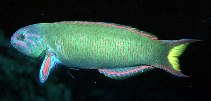
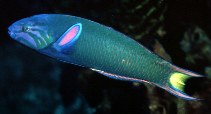
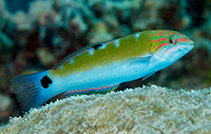
Ραχιαίες άκανθες (συνολικά) : 8; Μαλακές ραχιαίες ακτίνες (συνολικά) : 13; Εδρικές άκανθες: 3; Μαλακές εδρικές ακτίνες: 11. Adults are identified by the yellow lunate tail. Large males turn blue on the head that grades to green towards the tail (Ref. 48636). Body dark green to blue with vertical red to purplish red lines. Head green to blue with irregular pink to violet bands. Adults with large yellow crescent posteriorly in caudal fin and blue pectoral fins with a large elongate pink area distally. Juveniles with a large dark spot in middle of dorsal fin and a large diffuse black spot at base of caudal fin (Ref 9823).
Body shape (shape guide): fusiform / normal; Cross section: compressed.
Occurs solitary or in groups (Ref. 90102) in the upper portions of lagoon and coastal reefs, and in protected seaward reefs (Ref. 1602). Enters estuaries (Ref. 48636). Usually found on upper portions of ledges and heads (Ref. 9710). Feeds mainly on small benthic invertebrates and fish eggs (Ref. 9823). A protogynous hermaphrodite (Ref. 55367).
Κύκλος ζωής και συμπεριφορά ζευγαρώματος
Γεννητική Ωρίμανση | Αναπαραγωγή | Γεννοβολία | Αβγά | Γονιμότητα | Προνύμφες
A diandric species (Ref. 55367). Length at sex change = 11.0 cm TL, forms leks during breeding (Ref. 55367).
Randall, J.E., G.R. Allen and R.C. Steene, 1990. Fishes of the Great Barrier Reef and Coral Sea. University of Hawaii Press, Honolulu, Hawaii. 506 p. (Ref. 2334)
Κατάσταση Κόκκινου Καταλόγου IUCN (Ref. 130435: Version 2025-2 (Global))
Απειλή για τον άνθρωπο
Harmless
Ανθρώπινες χρήσεις
αλιεία: περιορισμένης εμπορικότητας; Ενυδρείο: Εμπορικό(ά)
Εργαλεία
Ειδικές εκθέσεις
Λήψη XML
Διαδικτυακές πηγές
Εκτιμήσεις βάσει μοντέλων
Προτιμώμενη θερμοκρασία (Αναφ.
123201): 24.6 - 29, mean 28 °C (based on 1296 cells).
Δείκτης φυλογενετικής ποικιλότητας (Αναφ.
82804): PD
50 = 0.5000 [Uniqueness, from 0.5 = low to 2.0 = high].
Bayesian length-weight: a=0.01259 (0.00818 - 0.01937), b=2.96 (2.84 - 3.08), in cm total length, based on LWR estimates for this species & Genus-body shape (Ref.
93245).
Τροφικό Επίπεδο (Αναφ.
69278): 4.2 ±0.27 se; based on food items.
Generation time: 5.8 ( na - na) years. Estimated as median ln(3)/K based on 1
growth studies.
Ελαστικότητα (Αναφ.
120179): Μεσαίο(α), ελάχιστος χρόνος για διπλασιασμό πληθυσμού 1,4 - 4,4 έτη (Preliminary K or Fecundity.).
Ευπάθεια στην αλιεία (Ref.
59153): Low to moderate vulnerability (35 of 100).
🛈
Θρεπτικά συστατικά (Ref.
124155): Calcium = 27.4 [12.5, 54.7] mg/100g; Iron = 0.542 [0.296, 1.065] mg/100g; Protein = 19.3 [16.5, 21.6] %; Omega3 = 0.187 [0.107, 0.327] g/100g; Selenium = 12.7 [6.2, 25.2] μg/100g; VitaminA = 59.7 [17.7, 239.8] μg/100g; Zinc = 0.877 [0.582, 1.481] mg/100g (wet weight);