>
Clupeiformes (Herrings) >
Engraulidae (Anchovies) > Engraulinae
Etymology: Stolephorus: Greek, stole, -es = garment + Greek, pherein = to carry (Ref. 45335).
Eponymy: This is a toponym; the Gulf of Carpentaria drainage is in Queensland, Australia, and the type locality was the Norman River. (Ref. 128868), visit book page.
Taxonomic Remarks
Species spelling and Year Paxton et al. 1989 (Ref. 7300:160).
Milieu: milieu / Klimaatzone / Diepte / verspreidingsgebied
Ecologie
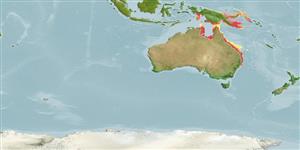
marien; brak water pelagic-neritic; diepte 10 - 13 m. Tropical; 3°S - 32°S, 134°E - 157°E (Ref. 189)
Western Pacific: Gulf of Carpentaria, southern coast of Papua New Guinea; also Moreton Bay near Brisbane, Queensland, Australia.
Lengte bij maturiteit / Grootte / Gewicht / Leeftijd
Maturiteit: Lm 5.0 range ? - ? cm
Max length : 5.0 cm SL mannelijk / geslacht onbekend; (Ref. 189)
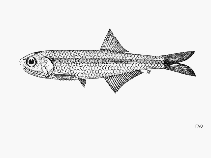
Dorsale stekels (totaal) : 0; Anale stekels: 0; Anale zachte stralen: 19 - 20. Belly with 5 to 7 small needle-like pre-pelvic scutes. Maxilla tip pointed, reaching to or beyond hind border of pre-operculum, the latter concave, indented near maxilla tip. Anal fin origin far forward, below the second to sixth dorsal fin ray bases. The advanced anal fin and the presence of fine teeth on hyoid bones distinguish this species from others in the area.
Body shape (shape guide): elongated; Cross section: compressed.
Presumed coastal, pelagic and schooling. Probably tolerates lowered salinities, judging from the type locality and its occurrence in bays and inlets. Apparently not abundant. More material needed.
Levenscyclus en paargedrag
Maturiteit | Voortplanting | Paaien | Eieren | Fecunditeit | Larven
Whitehead, P.J.P., G.J. Nelson and T. Wongratana, 1988. FAO Species Catalogue. Vol. 7. Clupeoid fishes of the world (Suborder Clupeoidei). An annotated and illustrated catalogue of the herrings, sardines, pilchards, sprats, shads, anchovies and wolf-herrings. FAO Fish. Synop. 125(7/2):305-579. Rome: FAO. (Ref. 189)
Status op de Rode Lijst van het IUCN (Ref. 130435: Version 2025-2 (Global))
Gevaar voor de mens
Harmless
Gebruik door de mens
Visserij: commercieel
Tools
Speciale rapporten
Download XML
Internetbronnen
Schattingen op basis van modellen
Gewenste temperatuur (Ref.
123201): 24.7 - 29.4, mean 27.7 °C (based on 470 cells).
Fylogenetische diversiteitsindex (Ref.
82804): PD
50 = 0.5000 [Uniqueness, from 0.5 = low to 2.0 = high].
Bayesian length-weight: a=0.00501 (0.00217 - 0.01155), b=3.14 (2.97 - 3.31), in cm total length, based on LWR estimates for this Genus-body shape (Ref.
93245).
Trofisch niveau (Ref.
69278): 3.2 ±0.4 se; based on size and trophs of closest relatives
Weerstandsvermogen (Ref.
120179): Hoog, minimale populatieverdubbelingstijd minder dan 15 maanden (K>0.3).
Kwetsbaarheid van de visserij (Ref.
59153): Low vulnerability (10 of 100).
🛈