分類 / 名稱
俗名 | 同種異名 | Catalog of Fishes(屬, 種) | ITIS | CoL | WoRMS | Cloffa
Teleostei >
Eupercaria/misc (Various families in series Eupercaria)
鱸形目 (Various families in series Eupercaria) >
Labridae (Wrasses)
隆頭魚科 (Wrasses) > Julidinae
Etymology: Hemigymnus: Greek, hemi = half + Greek, gymnos = naked (Ref. 45335).
More on author: Bloch.
環境: 環境 / 氣候帶 / 深度上下限 / 配送範圍
生態學
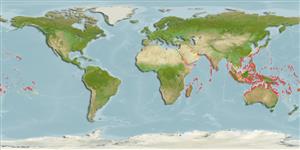
海洋 礁區魚類; 深度上下限 0 - 25 m (Ref. 90102). 熱帶; 30°N - 30°S, 33°E - 122°W
Indo-Pacific except the Red Sea.
印度-太平洋: 紅海 (參考文獻 1602) 南至英哈卡島, 莫三比克 (參考文獻 4392) 而且東至大溪地島。
大小 / 重量 / 年齡
成熟度: Lm ? range ? - ? cm
Max length : 30.0 cm TL 雄魚/尚未辨別雌雄; (Ref. 93095)
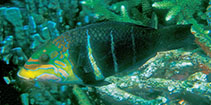
背棘 (總數) : 9; 背的軟條 (總數) : 10 - 11; 臀棘: 3; 臀鰭軟條: 11. Lips thick with age (Ref. 1623). Several color phases with age and sex (Ref. 48636). Basic color pattern changes little with growth although the posteriormost white bands disappear on large individuals (Ref. 1602).
Body shape (shape guide): fusiform / normal; Cross section: compressed.
唇隨著年齡變厚。 (參考文獻 1623) 用年齡與性別的一些色相.(參考文獻 48636) 雖然最後面的白色條紋在大的個體身上消失,基本彩色斑紋隨著成長改變不多。 (參考文獻 1602)
Found mostly on coral reefs and reef flats to at least 20 m depth. Juveniles secretive on inshore reefs. Large adults swim openly on reefs, singly or in small loose aggregations (Ref. 48636). Adults feed mainly by taking mouthfuls of sand and gravel, releasing sand from the gill opening after sorting the small animal prey and ejecting the inorganic fragments from the mouth. Gut contents may contain shrimps and 25% the crushed remains of the echinoids Echinometra and Diadema, these were large prey; remaining food material consisted of very small gastopods, bivalves, crabs, ophiuroids, foraminiferans, and unidentified eggs (Ref. 93095). Feed mainly on small crustaceans, mollusks and echinoderms (Ref. 9823). Minimum depth reported taken from Ref. 128797.
大部分發現於珊瑚礁與礁石平臺到至少 20 公尺深度上.。 主要捕食小型甲殼動物,軟體動物與棘皮動物。 (參考文獻 9823) 稚魚躲躲藏藏的在近海岩礁上。 大的成魚露天地在礁上游泳, 各別地或在小的鬆散魚群中.(參考文獻 48636)
生命週期和交配行為
成熟度 | 繁殖 | 產卵場 | 卵 | 孕卵數 | 仔魚
Oviparous, with distinct pairing during breeding (Ref. 205).印度-太平洋: 紅海 (參考文獻 1602) 南至英哈卡島, 莫三比克 (參考文獻 4392) 而且東至大溪地島。
Randall, J.E., 2013. Review of the Indo-Pacific labrid fish genus Hemigymnus. J. Ocean Sci. Found. 6:2-18. (Ref. 93095)
IUCN 瀕危狀態 (Ref. 130435: Version 2025-2 (Global))
無危 (LC) ; Date assessed: 12 June 2008
人類使用
漁業: 低經濟; 水族館: 商業性
工具
特別的報告
下載 XML
網路資源
基於模型的估計
首選溫度 (參考文獻
123201): 24.9 - 29.3, mean 28.3 °C (based on 3355 cells).
系統發育多樣性指數 (參考文獻
82804): PD
50 = 0.6250 [Uniqueness, from 0.5 = low to 2.0 = high].
Bayesian length-weight: a=0.00977 (0.00468 - 0.02039), b=3.07 (2.90 - 3.24), in cm total length, based on LWR estimates for this (Sub)family-body shape (Ref.
93245).
營養階層 (參考文獻
69278): 3.5 ±0.37 se; based on food items.
回復力 (參考文獻
120179): 中等的, 族群倍增時間最少 1.4 - 4.4年 (Preliminary K or Fecundity.).
釣魚的脆弱性 (Ref.
59153): Low vulnerability (20 of 100).
🛈
營養素 (Ref.
124155): Calcium = 35.1 [18.8, 107.6] mg/100g; Iron = 0.593 [0.350, 1.070] mg/100g; Protein = 18.6 [15.7, 20.8] %; Omega3 = 0.157 [0.081, 0.315] g/100g; Selenium = 29.4 [10.5, 74.1] μg/100g; VitaminA = 115 [36, 404] μg/100g; Zinc = 2.88 [0.91, 4.94] mg/100g (wet weight); based on
nutrient studies.