>
Eupercaria/misc (Various families in series Eupercaria) >
Labridae (Wrasses) > Julidinae
Etymology: Halichoeres: Greek, als, alis = salt + Greek, choiros = pig (Ref. 45335).
More on author: Bennett.
Ambiente: milieu / zona climatica / distribuzione batimetrica / gamma di distribuzione
Ecologia
marino associati a barriera corallina; distribuzione batimetrica 1 - 20 m (Ref. 90102). Tropical; 32°N - 24°S
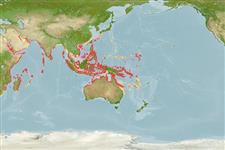
Indo-West Pacific: Red Sea and East Africa (Ref. 2334) to Papua New Guinea, north to Japan, south to the Great Barrier Reef in Australia.
Dimensione / Peso / Età
Maturità: Lm ? range ? - ? cm
Max length : 20.0 cm TL maschio/sesso non determinato; (Ref. 30573)
Breve descrizione
Chiavi di identificazione | Morfologia | Morfometria
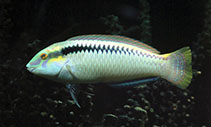
Spine dorsali (totale) : 9; Raggi dorsali molli (totale) : 11; Spine anali: 3; Raggi anali molli: 11. The initial phase is olivaceous to brownish yellow dorsally, white ventrally, with a black zigzag stripe running from eye to upper caudal peduncle (continuing anteriorly as a yellow stripe from the eye to the snout). This primary phase is similar to H. trimaculatus except for the black zigzag stripe along its back (Ref. 1602). The terminal phase is green, the zigzag stripe lavender-pink with its anterior portion overlaid by a black blotch.
Body shape (shape guide): fusiform / normal; Cross section: compressed.
Common in shallow lagoons or bays; usually over sand, rubble, or seagrass bottom (Ref. 41878), rather than on coral reefs. May be found in groups (Ref. 90102). Usually solitary and aggressive towards members of its own species. Feeds on small crustaceans by picking them off the sandy bottom (Ref. 5503).
Ciclo vitale e comportamento di accoppiamento
Maturità | Riproduzione | Deposizione | Uova | Fecondità | Larve
Distinct pairing during breeding (Ref. 205). Pelagic spawner (Ref. 32193).
Randall, J.E., G.R. Allen and R.C. Steene, 1990. Fishes of the Great Barrier Reef and Coral Sea. University of Hawaii Press, Honolulu, Hawaii. 506 p. (Ref. 2334)
Stato della Lista Rossa IUCN (Ref. 130435: Version 2025-2 (Global))
Minaccia per l'uomo
Harmless
Usi umani
Pesca: scarso interesse commerciale; Acquario: Commerciale
Strumenti
Rapporti speciali
Scarica XML
Fonti Internet
Stime basate su modelli
Temperatura preferita (Fonte Biblio.
123201): 26.2 - 29.3, mean 28.6 °C (based on 2756 cells).
Indice di diversità filogenetica (Fonte Biblio.
82804): PD
50 = 0.5000 [Uniqueness, from 0.5 = low to 2.0 = high].
Bayesian length-weight: a=0.01023 (0.00593 - 0.01767), b=3.14 (2.99 - 3.29), in cm total length, based on LWR estimates for this species & Genus-body shape (Ref.
93245).
Livello trofico (Fonte Biblio.
69278): 3.5 ±0.50 se; based on food items.
Generation time: 1.8 ( na - na) years. Estimated as median ln(3)/K based on 1
growth studies.
Resilienza (Fonte Biblio.
120179): Alto, tempo minimo di raddoppiamento della popolazione meno di 15 mesi (K=0.6).
Vulnerabilità della pesca (Ref.
59153): Low vulnerability (23 of 100).
🛈
Nutrienti (Ref.
124155): Calcium = 81.2 [48.7, 136.7] mg/100g; Iron = 0.733 [0.426, 1.332] mg/100g; Protein = 18.6 [15.7, 20.8] %; Omega3 = 0.147 [0.096, 0.229] g/100g; Selenium = 24 [15, 43] μg/100g; VitaminA = 108 [35, 388] μg/100g; Zinc = 1.57 [1.09, 2.43] mg/100g (wet weight);