>
Eupercaria/misc (Various families in series Eupercaria) >
Labridae (Wrasses) > Cheilioninae
Etymology: Cheilio: Greek, chanos, -eos, ous, and chasma, -atos = abyss, mouth opened, inmensity + Latin, muraena = morey eel (Ref. 45335).
More on author: Forsskål.
Môi trường: môi trường / vùng khí hậu / Mức độ sâu / phạm vi phân phối
Sinh thái học
biển cùng sống ở rạn san hô; mức độ sâu 1 - 30 m (Ref. 1602), usually 2 - 30 m (Ref. 27115). Tropical; 24°C - 27°C (Ref. 27115); 32°N - 36°S, 24°E - 109°W
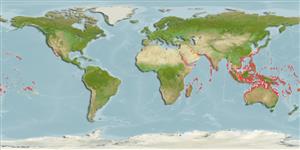
Indo-Pacific: Red Sea and East Africa to the Hawaiian and Easter islands, north to southern Japan, south to Lord Howe Island.
Bộ gần gũi / Khối lượng (Trọng lượng) / Tuổi
Chín muồi sinh dục: Lm ? range ? - ? cm
Max length : 50.0 cm SL con đực/không giới tính; (Ref. 9823); common length : 35.0 cm TL con đực/không giới tính; (Ref. 5450)
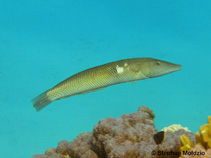
Các tia vây lưng cứng (tổng cộng) : 9; Các vây lưng mềm (tổng cộng) : 12 - 13; Tia cứng vây hậu môn: 3; Tia mềm vây hậu môn: 11 - 12. Young individuals are usually a mottled brown or green, sometimes with a broad lateral stripe (Ref. 1602). Rare individuals may be uniformly yellow (Ref. 1602). Coloration in this fish is variable: green, brown, orange-brown or yellow, often with narrow, midlateral, broken black stripe which are absent in large males (Ref. 86689). Large males may develop a bright yellow, orange, black, white, or multicolored patch on their sides behind their pectoral fins (Ref. 1602).
Body shape (shape guide): elongated; Cross section: circular.
Inhabit seagrass beds and algal-covered flats, occasionally in lagoon and seaward reefs to a depth of at least 30 m (Ref. 1602, 41878, 48636). Benthopelagic (Ref. 58302). Usually solitary. Juveniles secretive in seagrasses or attached Sargassum; adults usually in small loose aggregations, but occasionally form large schools to spawn (Ref. 48636). Feed mainly on crustaceans, mollusks, sea urchins (Ref. 37816) and other hard-shelled prey. Oviparous, distinct pairing during breeding (Ref. 205).
Vòng đời và hành vi giao phối
Chín muồi sinh dục | Sự tái sinh sản | Đẻ trứng | Các trứng | Sự sinh sản | Ấu trùng
Oviparous, distinct pairing during breeding (Ref. 205).
Randall, J.E., G.R. Allen and R.C. Steene, 1990. Fishes of the Great Barrier Reef and Coral Sea. University of Hawaii Press, Honolulu, Hawaii. 506 p. (Ref. 2334)
Tình trạng Sách đỏ IUCN (Ref. 130435: Version 2025-2 (Global))
Mối đe dọa đối với con người
Reports of ciguatera poisoning (Ref. 130160)
Sử dụng của con người
Các nghề cá: buôn bán nhỏ; Bể nuôi cá: Tính thương mại
Các công cụ
Báo cáo đặc biệt
Tải xuống XML
Các nguồn internet
Ước tính dựa trên mô hình
Nhiệt độ ưa thích (Tài liệu tham khảo
123201): 24.4 - 29, mean 27.7 °C (based on 1206 cells).
Chỉ số đa dạng phát sinh loài (Tài liệu tham khảo
82804): PD
50 = 1.0000 [Uniqueness, from 0.5 = low to 2.0 = high].
Bayesian length-weight: a=0.00339 (0.00239 - 0.00481), b=3.13 (3.03 - 3.23), in cm total length, based on LWR estimates for this species (Ref.
93245).
Mức dinh dưỡng (Tài liệu tham khảo
69278): 3.5 ±0.54 se; based on food items.
Thích nghi nhanh (Tài liệu tham khảo
120179): thấp, thời gian nhân đôi của chủng quần tối thiểu là 4.5 - 14 năm (Preliminary K or Fecundity.).
Sự dễ bị tổn thương của nghề đánh cá (Ref.
59153): Moderate vulnerability (44 of 100).
🛈
Chất dinh dưỡng (Ref.
124155): Calcium = 43.3 [22.3, 72.7] mg/100g; Iron = 0.482 [0.278, 0.936] mg/100g; Protein = 18.1 [15.2, 20.3] %; Omega3 = 0.0782 [, ] g/100g; Selenium = 34.1 [18.2, 65.8] μg/100g; VitaminA = 92.6 [27.1, 350.8] μg/100g; Zinc = 1.33 [0.91, 2.07] mg/100g (wet weight);