>
Eupercaria/misc (Various families in series Eupercaria) >
Labridae (Wrasses) > Cheilininae
Etymology: Oxycheilinus: Greek, oxys = sharp + Greek, cheilos = lip.
More on author: Günther.
Ambiente: milieu / zona climatica / distribuzione batimetrica / gamma di distribuzione
Ecologia
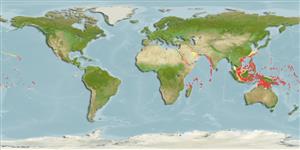
marino associati a barriera corallina; distribuzione batimetrica 0 - 80 m (Ref. 9823). Tropical; 30°N - 15°S
Indo-West Pacific: Red Sea, Indonesia to Ryukyu Is., Marshall Is.
Dimensione / Peso / Età
Maturità: Lm ? range ? - ? cm
Max length : 20.0 cm TL maschio/sesso non determinato; (Ref. 48636)
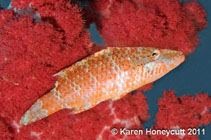
Spine dorsali (totale) : 9; Raggi dorsali molli (totale) : 10; Spine anali: 3; Raggi anali molli: 8; Vertebre: 23. Color of large adults red in life; body usually with 5 indistinct narrow pale bars that may contain white flecks, and 2 faint pale stripes along side; irregular bright red vertical lines on edges of scales anteriorly on midside and lower part of body, along with red dots; head with white to pale blue-green transverse lines on side of lower jaw, widest near front of chin; side of snout and head below eye with small dark-edged white to pale blue-green spots; iris orange-yellow with a blue ring, hind edge of eye black with a bright blue-green spot above (shows when eye directed forward); a blackish smudge on 2nd and 3rd lateral-line scales may be present (not related to sex); dorsal and anal fins light orange-red with oblique red lines and dark-edged white to blue lines or rows of dashes or small spots, the dorsal sometimes blackish on 1st membrane, rarely with a broad dusky border; caudal fin red with small white spots, often with an irregular blotchy white bar near base; pectoral fins with dark-edged pale yellowish rays and clear membranes; pelvic fins translucent whitish, blotched with red and flecked with white. Color of small adults light red, finely flecked with pink dorsally and white ventrally, with an orange-yellow stripe from chin to eye and along side of body to midbase of caudal fin; stripe on body broadly bordered above and below with a broad whitish band; edges of scales along midside of body with vertical red lines; two small midlateral bright red spots, one below middle of soft portion of dorsal fin and the other on base of caudal fin (Ref. 47566).
Body shape (shape guide): fusiform / normal; Cross section: compressed.
Found in coastal to outer reef habitats; juveniles often in crinoids or soft corals at moderate depths (Ref. 48636). Probably occurring deeper than normal diving depths (Ref. 35918). Reported to be associated with the mushroom Heliofungia actiniformis (Ref. 91291). Occurs among dense cover of coral rubble or algae. Feeds mainly on fishes, shrimps and other crustaceans. Known in outer reef lagoons to deep slopes with other invertebrates (Ref. 9002). Females swim in small groups (Ref. 48636). Minimum depth reported taken from Ref. 128797.
Ciclo vitale e comportamento di accoppiamento
Maturità | Riproduzione | Deposizione | Uova | Fecondità | Larve
Oviparous, distinct pairing during breeding (Ref. 205).
Westneat, M.W., 2001. Labridae. Wrasses, hogfishes, razorfishes, corises, tuskfishes. p. 3381-3467. In K.E. Carpenter and V. Niem (eds.) FAO species identification guide for fishery purposes. The living marine resources of the Western Central Pacific. Vol. 6. Bony fishes part 4 (Labridae to Latimeriidae), estuarine crocodiles. FAO, Rome. (Ref. 9823)
Stato della Lista Rossa IUCN (Ref. 130435: Version 2025-2 (Global))
Minaccia per l'uomo
Harmless
Usi umani
Pesca: scarso interesse commerciale; Acquario: Commerciale
Strumenti
Rapporti speciali
Scarica XML
Fonti Internet
Stime basate su modelli
Temperatura preferita (Fonte Biblio.
123201): 25 - 28.9, mean 27.9 °C (based on 362 cells).
Indice di diversità filogenetica (Fonte Biblio.
82804): PD
50 = 0.5010 [Uniqueness, from 0.5 = low to 2.0 = high].
Bayesian length-weight: a=0.01585 (0.00697 - 0.03603), b=2.96 (2.77 - 3.15), in cm total length, based on LWR estimates for this (Sub)family-body shape (Ref.
93245).
Livello trofico (Fonte Biblio.
69278): 3.8 ±0.62 se; based on food items.
Resilienza (Fonte Biblio.
120179): Alto, tempo minimo di raddoppiamento della popolazione meno di 15 mesi (Preliminary K or Fecundity.).
Vulnerabilità della pesca (Ref.
59153): Low vulnerability (10 of 100).
🛈
Nutrienti (Ref.
124155): Calcium = 70.9 [25.6, 161.5] mg/100g; Iron = 0.799 [0.294, 1.861] mg/100g; Protein = 18.6 [15.7, 20.8] %; Omega3 = 0.166 [0.084, 0.325] g/100g; Selenium = 31.4 [11.3, 94.6] μg/100g; VitaminA = 137 [42, 516] μg/100g; Zinc = 1.96 [0.85, 3.42] mg/100g (wet weight);