Окружающая среда: среда / климатическая зона / пределы глубины / диапазон распространения
экология
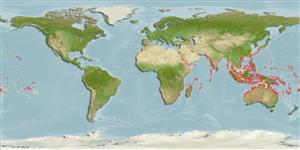
морской ассоциированный с рифами; немигрирующий (Ref. 52884); пределы глубины 0 - 30 m (Ref. 58304). Tropical; 36°N - 36°S, 28°E - 132°W
Indo-Pacific: East Africa to the Line and Tuamoto islands, north to southern Japan, south to the Lord Howe and the Austral islands. Closely related to Chaetodon decussatus.
Размер / Вес / Возраст
половая зрелость: Lm ? range ? - ? cm
Max length : 23.0 cm TL самец/пол неопределен; (Ref. 9710); common length : 15.0 cm TL самец/пол неопределен; (Ref. 5450)
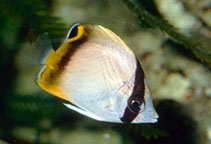
колючие лучи спинного плавника (общее число) : 13; членистые (мягкие) лучи спинного плавника (общее число) : 23 - 25; колючие лучи анального плавника: 3; членистые (мягкие) лучи анального плавника: 19 - 22. This species is distinguished by the following characters: snout length 2.5-3.2 in head length; greatest body depth 1.5-1.7 in SL. Body pattern chevron with narrow lines on side; black band across posterior body which does not include entire rear part of dorsal fin (Ref. 90102).
Body shape (shape guide): short and / or deep; Cross section: compressed.
Adults are found in reef flats, lagoon and seaward reefs and sometimes in turbid waters subject to freshwater runoff swimming in pairs. They are omnivorous, feeding on algae, coral polyps, crustaceans and worms (Ref. 5503). They are oviparous (Ref. 205) and monogamous (Ref. 52884). Stable monogamous pairs with both pair members jointly defending a feeding territory against other pairs (Ref. 58331) occur, but often accompany other species without being aggressive. They are easily maintained in tanks. Minimum depth reported taken from Ref. 128797.
Жизненный цикл и брачное поведение
половая зрелость | размножение | нерест | икра | Плодовитость | личинки
Distinct pairing (Ref. 205). Stable monogamous pairs with both pair members jointly defending a feeding territory. Pelagic larvae settle to shallow (<4 m) back reef habitats consisting of rubble, seagrass and low coral cover (Ref. 58331). Monogamous mating is observed as both obligate and social (Ref. 52884).
Myers, R.F., 1991. Micronesian reef fishes. Second Ed. Coral Graphics, Barrigada, Guam. 298 p. (Ref. 1602)
Статус Красного Списка МСОП (Ref. 130435: Version 2025-2 (Global))
Угроза для людей
Harmless
Использование человеком
рыболовство: не имеет хозяйственного значения; аквариум: коммерческий
дополнительная информация
инструменты
Специальные отчеты
Скачать в формате XML
ресурсы в Интернет
Оценки, основанные на моделях
Предпочтительная температура (ссылка
123201): 24.7 - 29.3, mean 28.4 °C (based on 3294 cells).
Индекс филогенетического разнообразия (ссылка
82804): PD
50 = 0.5000 [Uniqueness, from 0.5 = low to 2.0 = high].
Bayesian length-weight: a=0.01995 (0.01204 - 0.03308), b=2.98 (2.84 - 3.12), in cm total length, based on LWR estimates for this species & Genus-body shape (Ref.
93245).
Трофический уровень (ссылка
69278): 3.4 ±0.29 se; based on food items.
устойчивость к внешним воздействиям (ссылка
120179): высокий, минимальное время удвоения популяции до 15 месяцев (Preliminary K or Fecundity.).
Уязвимость рыбной ловли (Ref.
59153): Low vulnerability (13 of 100).
🛈
Питательные вещества (Ref.
124155): Calcium = 81.8 [43.3, 126.5] mg/100g; Iron = 0.74 [0.45, 1.17] mg/100g; Protein = 18.5 [17.4, 19.6] %; Omega3 = 0.107 [0.068, 0.165] g/100g; Selenium = 32.4 [18.8, 59.2] μg/100g; VitaminA = 44.8 [13.0, 147.3] μg/100g; Zinc = 1.36 [0.94, 1.94] mg/100g (wet weight);