>
Clupeiformes (Herrings) >
Engraulidae (Anchovies) > Engraulinae
Etymology: Encrasicholina: Greek, egkrasicholos, -os, -on = mixed with spleen.
More on author: Fowler.
Umwelt: Milieu / Klimazone / Tiefenbereich / Verbreitungsgebiet
Ökologie
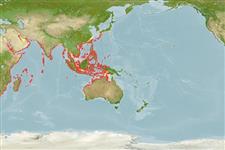
seewasser riff-verbunden; ozeanodrom (Ref. 51243); tiefenbereich 5 - 35 m (Ref. 86942). Tropical; 42°N - 35°S, 30°E - 140°E (Ref. 189)
Indo-Pacific: Red Sea and Persian Gulf south to perhaps Durban in South Africa, Pakistan, India, Sri Lanka, and probably Burma. Also from southern Japan to China, Philippines, Thailand, Indonesia south to Brisbane, Australia, Japan eastward to Hawaii, the Solomon Islands, Fiji, Samoa and Tahiti.
Länge bei der ersten Reifung / Größe / Gewicht / Alter
Geschlechtsreife: Lm ?, range 7 - ? cm
Max length : 13.0 cm TL Männchen/unbestimmt; (Ref. 189)
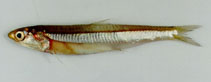
Rückenflossenstacheln (insgesamt) : 0; Rückenflossenweichstrahlen (insgesamt) : 12 - 15; Afterflossenstacheln: 0; Afterflossenweichstrahlen: 14 - 17. Belly rounded with 3 to 6 sharp needle-like pre-pelvic scutes. Maxilla tip blunt, scarcely projecting beyond second supra-maxilla, not reaching to front border of pre-operculum. Isthmus short, preceded by small fleshy plate on urohyal between branchial membranes. Anal fin short, its origin behind base of last dorsal fin ray.
Body shape (shape guide): fusiform / normal; Cross section: circular.
Epipelagic (Ref. 58302). A schooling species found inshore and in oceanic waters, hundreds of miles from land. Sometimes entering large atoll lagoons or deep, clear bays. Ranks among the most important food (bait) for tuna and other large pelagic fishes (Ref. 1602). Processed into nuoc-mam, a kind of fish pickle, in Indo-China (Ref. 4929).
Spawn in school (Ref. 205).
Whitehead, P.J.P., G.J. Nelson and T. Wongratana, 1988. FAO Species Catalogue. Vol. 7. Clupeoid fishes of the world (Suborder Clupeoidei). An annotated and illustrated catalogue of the herrings, sardines, pilchards, sprats, shads, anchovies and wolf-herrings. FAO Fish. Synop. 125(7/2):305-579. Rome: FAO. (Ref. 189)
IUCN Rote Liste Status (Ref. 130435: Version 2025-2 (Global))
Bedrohung für Menschen
Harmless
Nutzung durch Menschen
Fischereien: weniger kommerziell; Köder: usually
Tools
Zusatzinformationen
Download XML
Internet Quellen
Schätzungen auf der Grundlage von Modellen
Bevorzugte Temperatur (Ref.
123201): 24.7 - 29.2, mean 28.3 °C (based on 928 cells).
Phylogenetischer Diversitätsindex (Ref.
82804): PD
50 = 0.5005 [Uniqueness, from 0.5 = low to 2.0 = high].
Bayesian length-weight: a=0.00479 (0.00305 - 0.00750), b=3.26 (3.13 - 3.39), in cm total length, based on LWR estimates for this species & (Sub)family-body (Ref.
93245).
Trophische Ebene (Ref.
69278): 3.4 ±0.45 se; based on food items.
Widerstandsfähigkeit (Ref.
120179): hoch, Verdopplung der Population dauert weniger als 15 Monate. (K=1.1-2.0).
Anfälligkeit der Fischerei (Ref.
59153): Low vulnerability (12 of 100).
🛈
Nährstoffe (Ref.
124155): Calcium = 124 [38, 413] mg/100g; Iron = 1.16 [0.41, 3.17] mg/100g; Protein = 20 [17, 22] %; Omega3 = 0.323 [0.144, 0.762] g/100g; Selenium = 37.7 [12.9, 120.3] μg/100g; VitaminA = 49.4 [9.8, 236.8] μg/100g; Zinc = 1.28 [0.70, 3.00] mg/100g (wet weight);