>
Eupercaria/misc (Various families in series Eupercaria) >
Labridae (Wrasses) > Scarinae
Etymology: Chlorurus: Greek, chloros = green + Greek oura = tail (Ref. 45335).
More on author: Forsskål.
Ambiente: milieu / zona climática / intervalo de profundidade / gama de distribuição
Ecologia
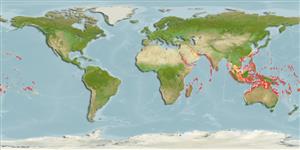
marinhas; estuarina associadas(os) a recifes; oceanódromo (Ref. 51243); intervalo de profundidade 0 - 50 m (Ref. 5213). Tropical; 30°N - 33°S, 30°E - 130°W
Indian Ocean.
Comprimento na primeira maturidade / Tamanho / Peso / Idade
Maturidade: Lm 15.0 range ? - ? cm
Max length : 40.0 cm TL macho/indeterminado; (Ref. 2334)
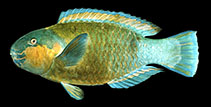
Espinhos dorsais (total) : 9; Raios dorsais moles (total) : 10; Espinhos anais: 3; Raios anais moles: 9. Initial phase very variable in coloration. Small individuals may be uniformly dark brown to light gray with or without the dark-centered light area on the caudal peduncle; large individuals may have a series of irregular rows of small light spots posteriorly or have the dark-centered light area on the caudal peduncle. The terminal phase is also variable with or without a large tan area on the side or on the caudal peduncle. Rounded snout (Ref. 48636).
Body shape (shape guide): fusiform / normal; Cross section: compressed.
One of the most widespread parrotfishes, but highly variable and some geographical forms that are probably subspecific (Ref. 48636). Inhabit both coral rich (Ref. 58652) and open pavement areas of shallow reef flats and lagoon and seaward reefs (Ref. 5213), as well as drop-offs, behaving differently in various areas (Ref. 48636). Benthopelagic (Ref. 58302). Juveniles found in coral rubble areas of reef flats and lagoons (Ref. 9710). Juveniles and individuals in the initial phase form large groups that migrate great distances between feeding and sleeping grounds (Ref. 9710). Feed on benthic algae (Ref. 30573). Minimum depth range reported taken from Ref. 30874. Protogynous (Ref. 55080). Minimum depth from Ref. 58018.
Ciclo de vida e comportamento de acasalamento
Maturidade | Reprodução | Desova | Ovos | Fecundidade | Larvas
Oviparous, distinct pairing during breeding (Ref. 205). Size at sex change: 35.1 - 47.2 cm TL (Ref. 55080).
Eschmeyer, W.N., 1997. PISCES. Eschmeyer's PISCES database as published on the Internet in June 1997, URL: gopher://gopher.calacademy.org:640/7. (Ref. 12965)
Categoria na Lista Vermelha da IUCN (Ref. 130435: Version 2025-2 (Global))
Ameaça para o homem
Reports of ciguatera poisoning (Ref. 31637)
Utilização humana
Pescarias: espécies comerciais; Aquário: Espécies comerciais
Ferramentas
Relatórios especiais
Descarregue XML
Fontes da internet
Estimativas baseadas em modelos
Temperatura preferida (Ref.
123201): 24.6 - 28.8, mean 27.5 °C (based on 582 cells).
Índice de diversidade filogenética (Ref.
82804): PD
50 = 0.5000 [Uniqueness, from 0.5 = low to 2.0 = high].
Bayesian length-weight: a=0.01413 (0.01207 - 0.01653), b=3.06 (3.02 - 3.10), in cm total length, based on LWR estimates for this species (Ref.
93245).
Nível Trófico (Ref.
69278): 2.6 ±0.29 se; based on food items.
Resiliência (Ref.
120179): Médio, tempo mínimo de duplicação da população 1,4 - 4,4 anos (tmax=9; k >0.3).
Vulnerabilidade da pesca (Ref.
59153): Low to moderate vulnerability (27 of 100).
🛈
Nutrientes (Ref.
124155): Calcium = 40.5 [17.6, 133.5] mg/100g; Iron = 0.726 [0.311, 1.762] mg/100g; Protein = 19.1 [17.2, 20.9] %; Omega3 = 0.112 [0.056, 0.221] g/100g; Selenium = 46.3 [16.3, 119.9] μg/100g; VitaminA = 30 [10, 92] μg/100g; Zinc = 2.46 [1.10, 4.16] mg/100g (wet weight); based on
nutrient studies.