>
Eupercaria/misc (Various families in series Eupercaria) >
Labridae (Wrasses) > Scarinae
Etymology: Scarus: Greek, skaros = a fish described by anciente writers as a parrot fish; 1601 (Ref. 45335).
More on author: Bleeker.
Umwelt: Milieu / Klimazone / Tiefenbereich / Verbreitungsgebiet
Ökologie
seewasser riff-verbunden; tiefenbereich 1 - 36 m (Ref. 5227). Tropical; 30°N - 27°S
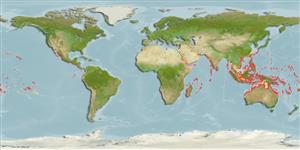
Indo-Pacific: East Africa south to Durban, South Africa (Ref. 5490) and east to the Tuamoto Islands, north to the Ryukyu and Hawaiian islands, south to Shark Bay, Western Australia and the southern Great Barrier Reef. Excluding Rapa and Austral Islands (Ref. 86689). Eastern Pacific: Gulf of California to the Galapagos Islands (Ref. 5227).
Größe / Gewicht / Alter
Geschlechtsreife: Lm ? range ? - ? cm
Max length : 70.0 cm TL Männchen/unbestimmt; (Ref. 2334); max. veröff. Alter: 20 Jahre (Ref. 42001)
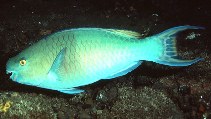
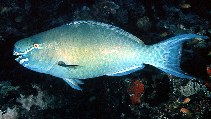
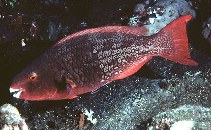
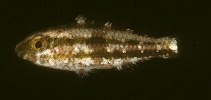
Rückenflossenstacheln (insgesamt) : 9; Rückenflossenweichstrahlen (insgesamt) : 10; Afterflossenstacheln: 3; Afterflossenweichstrahlen: 9. This species is distinguished by the following characters: 6 median predorsal scales; 3 scale rows on cheek 1(5-7), 2(5-7), 3(1-3); pectoral-fin rays 14-16 (usually 15); conical teeth on side, 0-1 on upper dental plate of female, 1-3 on terminal male; lips mainly covering half or more of dental plates; terminal male with angular snout profile; caudal fin slightly emarginate in female, lunate with prolonged lobes in terminal male. Colour of male with distinct bicolour pattern, brownish to dark green on head and anterior body and lighter green on posterior portion; female reddish brown to grey with small black spots and irregular black lines and white flakes on body (Ref. 9793, 90102).
Body shape (shape guide): fusiform / normal; Cross section: compressed.
Occurs solitary or in pairs in seaward reefs (Ref. 90102). Usually over rocky or coral substrates, at boulder-strewn slopes at the base of high-island cliffs where it may occur in large schools. Large adult usually on upper parts of deep slopes, but seen to about 35 m depth (Ref. 48636). Benthopelagic (Ref. 58302). Feeds on benthic algae (Ref. 30573). A protogynous hermaphrodite (Ref. 55367). An uncommon species (Ref. 9338).
Lebenszyklus und Paarungsverhalten
Geschlechtsreife | Fortpflanzung | Ablaichen | Eier | Fruchtbarkeit | Larven
Oviparous, distinct pairing during breeding (Ref. 205). Sex change occurs at 37.4 cm TL and 13 years of age (Ref. 55367).
Randall, J.E., G.R. Allen and R.C. Steene, 1990. Fishes of the Great Barrier Reef and Coral Sea. University of Hawaii Press, Honolulu, Hawaii. 506 p. (Ref. 2334)
IUCN Rote Liste Status (Ref. 130435: Version 2025-2 (Global))
Bedrohung für Menschen
Harmless
Nutzung durch Menschen
Fischereien: kommerziell; Aquarium: Kommerziell
Tools
Zusatzinformationen
Download XML
Internet Quellen
Schätzungen auf der Grundlage von Modellen
Bevorzugte Temperatur (Ref.
123201): 24.9 - 29.3, mean 28.3 °C (based on 3457 cells).
Phylogenetischer Diversitätsindex (Ref.
82804): PD
50 = 0.5000 [Uniqueness, from 0.5 = low to 2.0 = high].
Bayesian length-weight: a=0.01514 (0.01266 - 0.01810), b=3.05 (3.02 - 3.08), in cm total length, based on LWR estimates for this species (Ref.
93245).
Trophische Ebene (Ref.
69278): 2.0 ±0.00 se; based on food items.
Widerstandsfähigkeit (Ref.
120179): mittel, Verdopplung der Population dauert 1,4 - 4,4 Jahre. (tmax=20; K >0.30).
Anfälligkeit der Fischerei (Ref.
59153): Low to moderate vulnerability (30 of 100).
🛈
Nährstoffe (Ref.
124155): Calcium = 31 [20, 55] mg/100g; Iron = 0.733 [0.512, 1.100] mg/100g; Protein = 18.8 [16.7, 20.6] %; Omega3 = 0.0845 [, ] g/100g; Selenium = 24.3 [15.5, 38.2] μg/100g; VitaminA = 29.9 [8.9, 101.8] μg/100g; Zinc = 1.87 [1.42, 2.42] mg/100g (wet weight); based on
nutrient studies.