>
Eupercaria/misc (Various families in series Eupercaria) >
Labridae (Wrasses) > Scarinae
Etymology: Scarus: Greek, skaros = a fish described by anciente writers as a parrot fish; 1601 (Ref. 45335).
สิ่งแวดล้อม : สิ่งแวดล้อม / เขตภูมิอากาศ / ระดับความลึก / ระยะการกระจายสินค้า
นิเวศวิทยา
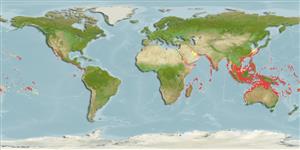
เกี่ยวกับทะเล,น้ำเค็ม; กร่อย เกี่ยวกับหินโสโครก; ระดับความลึก 1 - 90 m (Ref. 89642). Tropical; 31°N - 35°S, 21°E - 77°W
Indo-West Pacific: Algoa Bay, South Africa and Red Sea (Ref. 5490), Persian Gulf (Ref. 80050) to Rapa and Ducie islands, north to southern Japan, south to Perth, New South Wales. Likely in Seychelles (Ref. 1623). Eastern Pacific: Gulf of California to Ecuador (Ref. 5227). Lessepsian migrant to the Mediterranean. First of Family Scaridae (Ref. 45081).
ความยาวเมื่อครบกำหนดครั้งแรก / ขนาด / น้ำหนัก / อายุ
วัยเจริญพันธุ์: Lm ?, range 49 - ? cm
Max length : 75.0 cm TL เพศผู้/กระเทย; (Ref. 90102); common length : 30.0 cm TL เพศผู้/กระเทย; (Ref. 55763); อายุสูงสุดที่ได้รายงาน: 13 ปี (Ref. 42001)
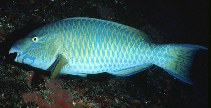
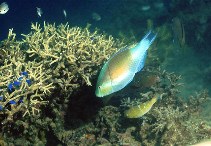
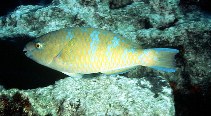
เงี่ยงครีบหลัง (รวม) : 9; ก้านครีบอ่อนที่หาง (รวม) : 10; เงี่ยงครีบก้น: 3; ก้านครีบอ่อนที่ก้น: 9. This species is distinguished by the following characters: median predorsal scales 6-8 (usually 7); 3 scale rows on cheek, 1(6-7), 2(6-9), 3(3-5); pectoral-fin rays 13-15 (occasionally 15); terminal male usually with 2 conical teeth on side of upper dental plate (female without), with lips mainly covering the plates; caudal fin rounded in small female, with prolonged lobes in large adult. Colour of male dark reddish brown anteriorly with a bright green dot at top end of line from mouth through eye to top of opercular opening; female red on head, belly and fins, side with wavy black and white stripes, and dark green bands around the mouth and eye (Ref. 9793, 90102).
Body shape (shape guide): fusiform / normal; Cross section: compressed.
Adults inhabit lagoon and seaward reefs (Ref. 1602), in slopes and drop-offs (Ref. 48636), often solitary but may sometimes occur in small groups (Ref. 9710, 48636). Males common in atolls where they live mainly around the inner and outer edges of barrier reefs at depths of about 30 ft; females prefer deeper habitat (Ref. 4821). Small juveniles in groups are found inshore on algae reef habitat (Ref. 9710, 48636) and sometimes enter silty, murky environments (Ref. 5490). Feed by scraping algae from rocks and corals (Ref. 5227). Are protogynous hermaphrodites (Ref. 55367). Caught with nets and other types of artisanal gear. Marketed fresh (Ref. 5284). In the Hong Kong live fish markets (Ref. 27253). Minimum depth reported from Ref. 90102.
วงจรชีวิตและพฤติกรรมการผสมพันธุ์
วัยเจริญพันธุ์ | การสืบพันธุ์ | การวางไข่ | เซลสืบพันธ์ของเพศเมีย(ไข่) | ความดกของไข่ | ตัวอ่อน
Oviparous, distinct pairing during breeding (Ref. 205). Sex change occurs at 29.0 cm TL and 7 years of age (Ref. 55367).
Parenti, P. and J.E. Randall, 2000. An annotated checklist of the species of the labroid fish families Labridae and Scaridae. Ichthyol. Bull. J.L.B. Smith Inst. Ichthyol. (68):1-97. (Ref. 35918)
สถานะบัญชีแดงของ IUCN (Ref. 130435: Version 2025-2 (Global))
ภัยคุกคามต่อมนุษย์
Harmless
การใช้ของมนุษย์
การประมง: การค้า; สถานที่แสดงสัตว์และพืชน้ำ: การค้า
เครื่องมือ
รายงานพิเศษ
ดาวน์โหลด XML
แหล่งที่มาจากอินเตอร์เน็ต
การประมาณค่าตามแบบจำลอง
อุณหภูมิที่ต้องการ (อ้างอิง
123201): 24.5 - 29.1, mean 28 °C (based on 1802 cells).
ดัชนีความหลากหลายทางวิวัฒนาการ (อ้างอิง
82804): PD
50 = 0.5000 [Uniqueness, from 0.5 = low to 2.0 = high].
Bayesian length-weight: a=0.01445 (0.01210 - 0.01727), b=3.04 (3.01 - 3.07), in cm total length, based on LWR estimates for this species (Ref.
93245).
ระดับชั้นอาหาร (อ้างอิง
69278): 2.0 ±0.0 se; based on diet studies.
ความสามารถในการกลับคืนสู่ปกติ (อ้างอิง
120179): ขนาดกลาง, เวลาต่ำสุดที่จะทำให้ประชากรเพิ่มขึ้นเป็น 2 เท่าใช้เวลา 1.4 - 4.4 ปี (K=0.47; tmax=13).
Prior r = 0.55, 95% CL = 0.36 - 0.83, Based on 1 data-limited stock assessment.
ความเสี่ยงต่อการตกปลา (Ref.
59153): Moderate to high vulnerability (50 of 100).
🛈
ความเสี่ยงต่อสภาพภูมิอากาศ (Ref.
125649): High to very high vulnerability (74 of 100).
🛈
สารอาหาร (Ref.
124155): Calcium = 25 [14, 42] mg/100g; Iron = 0.629 [0.410, 0.980] mg/100g; Protein = 18.9 [16.8, 20.7] %; Omega3 = 0.0973 [, ] g/100g; Selenium = 25.9 [14.6, 41.5] μg/100g; VitaminA = 34 [10, 113] μg/100g; Zinc = 2.13 [1.50, 2.72] mg/100g (wet weight); based on
nutrient studies.