>
Eupercaria/misc (Various families in series Eupercaria) >
Labridae (Wrasses) > Scarinae
Etymology: Scarus: Greek, skaros = a fish described by anciente writers as a parrot fish; 1601 (Ref. 45335).
More on author: Steindachner.
Environnement : milieu / zone climatique / profondeur / gamme de distribution
Écologie
marin récifal; profondeur 1 - 50 m (Ref. 37816). Tropical; 32°N - 32°S, 132°E - 124°W
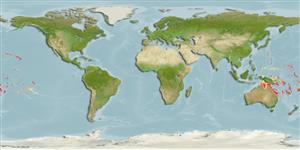
Pacific Ocean: Ryukyu Island to the Line and Ducie Islands, north to southern Japan, south to Lord Howe and Rapa Islands; throughout Micronesia.
Taille / Poids / Âge
Maturité: Lm ? range ? - ? cm
Max length : 60.0 cm TL mâle / non sexé; (Ref. 9710); common length : 41.0 cm SL mâle / non sexé; (Ref. 37816)
Description synthétique
Clés d'identification | Morphologie | Morphométrie
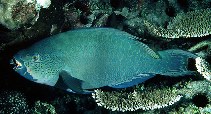
Épines dorsales (Total) : 9; Rayons mous dorsaux (Total) : 10; Épines anales: 3; Rayons mous anaux: 9. This is the only Scarus in which one of the middle dorsal rays of terminal males is produced into a slightly elongate filament. Small juveniles have a distinctive yellow head and striped to mottled body (Ref. 1602).
Body shape (shape guide): fusiform / normal; Cross section: compressed.
Often found in large groups (Ref. 90102). Adults usually seen along the reef margin of seaward reefs while juveniles and subadults are found in shallow protected reefs (Ref. 9710). Feeds mainly on algae (Ref. 26993). Occurs to a depth of over 50 m (Ref. 1602). Adults and subadults form groups, juveniles usually solitary (Ref. 9710). Minimum depth of 1 m reported from Ref. 90102.
Cycle de vie et comportement reproducteur
Maturité | Reproduction | Frai | Œufs | Fécondité | Larves
Oviparous, distinct pairing during breeding (Ref. 205).
Parenti, P. and J.E. Randall, 2000. An annotated checklist of the species of the labroid fish families Labridae and Scaridae. Ichthyol. Bull. J.L.B. Smith Inst. Ichthyol. (68):1-97. (Ref. 35918)
Statut dans la liste rouge de l'IUCN (Ref. 130435: Version 2025-2 (Global))
Menace pour l'homme
Reports of ciguatera poisoning (Ref. 130160)
Utilisations par l'homme
Outils
Articles particuliers
Télécharger en XML
Sources Internet
Estimations basées sur des modèles
Température préférée (Réf.
123201): 24.5 - 28, mean 26.7 °C (based on 134 cells).
Indice de diversité phylogénétique (Réf.
82804): PD
50 = 0.5000 [Uniqueness, from 0.5 = low to 2.0 = high].
Bayesian length-weight: a=0.01413 (0.01162 - 0.01717), b=3.04 (3.01 - 3.07), in cm total length, based on LWR estimates for this species (Ref.
93245).
Niveau trophique (Réf.
69278): 2.0 ±0.00 se; based on food items.
Generation time: 4.3 ( na - na) years. Estimated as median ln(3)/K based on 2
growth studies.
Résilience (Réf.
120179): Faible, temps minimum de doublement de population : 4,5 à 14 années (K=0.25; tmax=13).
Vulnérabilité de la pêche (Ref.
59153): Low to moderate vulnerability (27 of 100).
🛈
Nutriments (Ref.
124155): Calcium = 33.7 [21.6, 61.0] mg/100g; Iron = 0.766 [0.541, 1.157] mg/100g; Protein = 18.7 [16.7, 20.5] %; Omega3 = 0.0897 [, ] g/100g; Selenium = 25.5 [16.2, 39.5] μg/100g; VitaminA = 31 [9, 106] μg/100g; Zinc = 1.96 [1.47, 2.52] mg/100g (wet weight);