Lingkungan: lingkungan / zona iklim / kisaran kedalaman / jangkauan distribusi
Ekologi
; air tawar bentopelagis; potamodromous (Ref. 51243). Tropical
Asia: Thailand (Bang Pakong, Chao Phraya, Mae Klong, and Phetchaburi
basins) and Mekong basin in Cambodia, Lao PDR, Thailand, and Vietnam.
Panjang pada saat jatuh tempo pertama / Ukuran / Berat / umur
Kematangan: Lm 20.0 range ? - ? cm
Max length : 20.0 cm SL jantan/; (Ref. 33488)
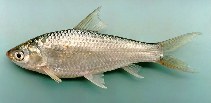
This species is distinguished from its congeners by the following set of characters: mouth terminal, strongly oblique (35–45° to midline of body); no maxillary barbels; edge of rostral cap is straight, no medial indent; flank immaculate, no longitudinal stripes; caudal peduncle immaculate, no spot; caudal fin mostly clear, with scattered melanophores; in life, pectoral, pelvic, and anal fins hyaline (Ref. 123185).
Cross section: compressed.
Often found in great abundance at midwater to bottoms depths in large and small rivers. Feeds on algae, periphyton and phytoplankton. Not known to prosper in impoundments. Well known for its annual trophic migrations out to the floodplains in wet season. Returns to rivers as water levels begin to fall in October with numbers increasing through December and then slowly declining (Ref. 12693). From just upstream Phnom Penh in Cambodia to the Khone Falls this species is reported to migrate upstream during the period October-February. At Muk Kompul in Kandal Province, it migrates upstream just before the full moon. Further upstream near Kratie, migration occurs during full moon and at Sambor, migration takes place immediately after full moon. Near the Khone Falls, upstream movements continue through March but in April fish are moving in both direction. From May to July, at the start of the rainy season, it migrates downstream from the Khone Falls to the Mekong Delta. Here, the fish is reported to move out of the Mekong into canals and flooded areas in August-September. When water recedes in November-December, fish migrates to the Mekong again. Upstream the Khone Falls near Ubolratchatani in Thailand, this species moves upstream between February and June, consisting mainly of juveniles in February-March and of adults (15-20 cm) in April-June. Further upstream from Xayabouri in Laos to Chiang Khong in Thailand, upstream migrations takes place between March to July, first by juveniles, later by adults (Ref. 37770). Used to make prahoc along the Tonlé Sap, Cambodia. Often seen in the aquarium trade (Ref. 12693).
Siklus hidup dan perilaku kawin
Kematangan | Reproduksi, perkembang biakan | Pemijahan | telur-telur | Fekunditas | Larva
Ciccotto, P.J. and L.M. Page, 2020. Revision of the genus Henicorhynchus, with a revised diagnosis of Gymnostomus (Cyprinidae: Labeoninae). Copeia 108 (3):485-502. (Ref. 123185)
Status IUCN Red List (Ref. 130435: Version 2025-2 (Global))
ancaman kepada manusia
Harmless
penggunaan manusia
Perikanan: komersial; Akuarium: Komersial
Alat, peralatan
laporan khas
muat turun XML
Sumber internet
Estimasi berdasarkan model
Indeks keanekaragaman filogenetik (Acuan
82804): PD
50 = 0.5312 [Uniqueness, from 0.5 = low to 2.0 = high].
Bayesian length-weight: a=0.00977 (0.00546 - 0.01749), b=2.99 (2.84 - 3.14), in cm total length, based on LWR estimates for this species & (Sub)family-body (Ref.
93245).
Tingkat Trofik (Acuan
69278): 2.0 ±0.00 se; based on food items.
Generation time: 1.5 ( na - na) years. Estimated as median ln(3)/K based on 1
growth studies.
Daya lenting (Acuan
120179): Tinggi, Waktu penggandaan populasi minimum kurang dari 15 bulan (Preliminary K or Fecundity.).
Kerentanan Penangkapan Ikan (Ref.
59153): Low vulnerability (14 of 100).
🛈
Nutrisi (Ref.
124155): Calcium = 107 [58, 253] mg/100g; Iron = 2.16 [1.43, 3.31] mg/100g; Protein = 17.8 [16.1, 19.2] %; Omega3 = 0.494 [0.207, 1.168] g/100g; Selenium = 73.6 [30.7, 165.7] μg/100g; VitaminA = 63.2 [16.6, 244.7] μg/100g; Zinc = 3.01 [2.14, 4.21] mg/100g (wet weight); based on
nutrient studies.