Entorno: milieu / zona climática / rango de profundidad / gama de distribución
Ecología
; agua dulce bentopelágico; potamodromo (Ref. 51243). Tropical
Asia: Thailand (Chao Phraya and Mae Klong basins) and the Mekong basin in Cambodia, Lao PDR, Thailand, and Vietnam.
Tamaño / Peso / Edad
Madurez: Lm ? range ? - ? cm
Max length : 15.0 cm SL macho / no sexado; (Ref. 30857)
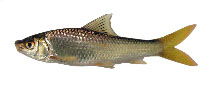
This species is distinguished from its congeners by the following set of characters: mouth subterminal, weakly oblique to nearly horizontal (less than or equal to 20° to midline of body); maxillary barbels are almost always present (rarely absent); edge of rostral cap with a distinct medial indent; flank immaculate, no longitudinal stripes; caudal peduncle immaculate or with brown to black spot at the medial insertion of caudal fin; caudal fin mostly clear, with scattered melanophores; pectoral, pelvic, and anal fins hyaline in life (Ref. 123185).
Cross section: compressed.
Occur in rapids and in slow flowing water (Ref. 37771). It may be the single most abundant species in the Mekong basin and is certainly an ecological keystone species. Collected in numerous tributaries as small as 2-3 m wide in widely separated localities in Thailand, Laos and Cambodia. In terms of absolute numbers, it is the most abundant fish species in the major migrations that occur in the mainstream of the Mekong River below Khone Falls every December-February and May-July, where there is an important artisanal fisheries. Probably the single most important forage or prey species for many piscivore fish species present there, and may also be heavily preyed upon by the local dolphin, Orcaella brevirostris . Is one of the lead species in the massive migrations of cyprinid fishes moving up the Mekong mainstream in the Khone Falls area. Most of these falls represent an impassable physical obstacle to the migrators, but they can be avoided by going up one or two of the large "hoo" or channels (most importantly Hoo Sahong) and smaller pathways, thus by-passing the impassable falls and more difficult rapids. Employs a strategy, "the ever-changing leadership strategy for finding the pathway of least resistance", which can only be successful when very large numbers of individuals are migrating. As the migrating fish move upstream, the leading fish are blocked or fail to find a way onwards, some fish turn back and look for other routes. Therefore the leadership of the migrators is constantly changing, until some leaders are successful in getting past obstacles and take large numbers of followers with them.
Ciclo vital y comportamiento de apareamiento
Madurez | Reproducción | Puesta | Huevos | Fecundidad | Larva
Reproductive mode needs confirmation (Ref. 43281).
Ciccotto, P.J. and L.M. Page, 2020. Revision of the genus Henicorhynchus, with a revised diagnosis of Gymnostomus (Cyprinidae: Labeoninae). Copeia 108 (3):485-502. (Ref. 123185)
Situación en la Lista Roja de la UICN (Ref. 130435: Version 2025-2 (Global))
Amenaza para el ser humano
Harmless
Usos humanos
Herramientas
Informes especiales
Descargar XML
Fuentes de Internet
Estimaciones basadas en modelos
Índice de diversidad filogenética (Referencia
82804): PD
50 = 0.5312 [Uniqueness, from 0.5 = low to 2.0 = high].
Bayesian length-weight: a=0.00933 (0.00435 - 0.02001), b=3.05 (2.88 - 3.22), in cm total length, based on LWR estimates for this (Sub)family-body shape (Ref.
93245).
Nivel trófico (Referencia
69278): 2.2 ±0.1 se; based on size and trophs of closest relatives
Resiliencia (Referencia
120179): Alto, población duplicada en un tiempo mínimo inferior a 15 meses (Preliminary K or Fecundity.).
Vulnerabilidad pesquera (Ref.
59153): Low vulnerability (10 of 100).
🛈