Environnement : milieu / zone climatique / profondeur / gamme de distribution
Écologie
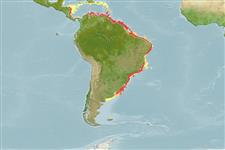
marin; eau douce; saumâtre pelagic-neritic; anadrome (Ref. 51243); profondeur ? - 40 m (Ref. 5217). Subtropical; 19°N - 41°S, 88°W - 34°W (Ref. 101638)
Western Atlantic: Belize (but no southerly records until Lake Maracaibo, Venezuela); then from Gulf of Venezuela and Trinidad south to Argentina at Carmen de Patagones; also lower and sometimes middle parts of the Orinoco, the Amazon to above Manaus, and Paraná to about Corrientes, and in smaller rivers.
Longueur à la première maturité / Taille / Poids / Âge
Maturité: Lm 11.2 range ? - ? cm
Max length : 23.5 cm SL mâle / non sexé; (Ref. 50628); common length : 20.0 cm TL mâle / non sexé; (Ref. 5217); poids max. publié: 57.00 g (Ref. 118626)
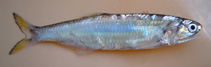
Épines dorsales (Total) : 0; Rayons mous dorsaux (Total) : 13 - 14; Épines anales: 0; Rayons mous anaux: 21 - 28. Depth widely variable. Snout about 2/3 eye diameter; maxilla moderate, pointed, reaching onto sub-operculum. Gill rakers short, the longest not less than pupil diameter in adults. Dorsal fin origin behind midpoint of body; anal fin origin below 6th-8th branched dorsal fin rays. Silver stripe up to twice eye diameter at widest, lost in fishes over 10 cm SL. Curve of black dots on operculum (Ref. 189). Grayish blue dorsally, fins yellowish with translucent membranes and a blackish caudal margin (Ref. 27363).
Body shape (shape guide): fusiform / normal; Cross section: compressed.
Occurs in brackish estuaries and adjacent marine areas; penetrates freshwater (Ref. 5217). Forms moderate schools. Usually migrating from estuaries or the sea, but possibly the limnichthys of Lake Maracaibo and the amazonensis represent purely freshwater forms. In freshwater, it feeds principally on small fishes, prawns and copepods; also insect larvae. At sea, it feeds on fishes and various crustaceans. Spawns in freshwater. Year round occurrence of eggs reported.
Spawn in school (Ref. 205).
Whitehead, P.J.P., G.J. Nelson and T. Wongratana, 1988. FAO Species Catalogue. Vol. 7. Clupeoid fishes of the world (Suborder Clupeoidei). An annotated and illustrated catalogue of the herrings, sardines, pilchards, sprats, shads, anchovies and wolf-herrings. FAO Fish. Synop. 125(7/2):305-579. Rome: FAO. (Ref. 189)
Statut dans la liste rouge de l'IUCN (Ref. 130435: Version 2025-2 (Global))
Menace pour l'homme
Harmless
Utilisations par l'homme
Pêcheries: intérêt commercial mineur
Outils
Articles particuliers
Télécharger en XML
Sources Internet
Estimations basées sur des modèles
Température préférée (Réf.
123201): 15.1 - 28, mean 26.2 °C (based on 250 cells).
Indice de diversité phylogénétique (Réf.
82804): PD
50 = 0.5312 [Uniqueness, from 0.5 = low to 2.0 = high].
Bayesian length-weight: a=0.00575 (0.00467 - 0.00709), b=3.16 (3.10 - 3.22), in cm total length, based on LWR estimates for this species (Ref.
93245).
Niveau trophique (Réf.
69278): 3.7 ±0.67 se; based on food items.
Résilience (Réf.
120179): Milieu, temps minimum de doublement de population : 1,4 à 4,4 années (Assuming tmax>3).
Vulnérabilité de la pêche (Ref.
59153): Moderate vulnerability (35 of 100).
🛈
Nutriments (Ref.
124155): Calcium = 117 [67, 246] mg/100g; Iron = 1.64 [0.93, 2.82] mg/100g; Protein = 19.7 [18.3, 21.2] %; Omega3 = 0.718 [0.413, 1.409] g/100g; Selenium = 15.1 [7.6, 31.0] μg/100g; VitaminA = 20.2 [6.2, 55.2] μg/100g; Zinc = 1.05 [0.73, 1.51] mg/100g (wet weight);