>
Anguilliformes (Eels and morays) >
Congridae (Conger and garden eels) > Heterocongrinae
Etymology: Gorgasia: From Greek mithology, Gorgas, -ados = the Gorgone´s head (Ref. 45335).
Eponymy: General William Crawford Gorgas (1854–1920) was an epidemiologist and Surgeon General of the US Army. [...] Ludwig Sillner (1914–1973) was a German pioneering underwater photographer. [...] (Ref. 128868), visit book page.
Entorno: milieu / zona climática / rango de profundidad / gama de distribución
Ecología
marino demersal. Tropical
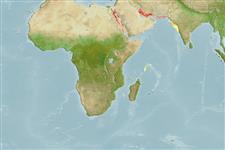
Western Indian Ocean: Gulf of Aqaba, Red Sea.
Tamaño / Peso / Edad
Madurez: Lm ? range ? - ? cm
Max length : 83.8 cm TL macho / no sexado; (Ref. 33408)
Ciclo vital y comportamiento de apareamiento
Madurez | Reproducción | Puesta | Huevos | Fecundidad | Larva
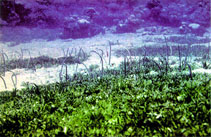
Spawning begins early in the morning. From variable colonies in a reef, each eel occupies a burrow it has dug, reaching into the water column to pick out the plankton for food. Prior to spawning, the male and female move their burrows close together; whether the male or the female moves is not known. The male then defends the female from other males, and prolonged and vigorous inter-male combat is common.
On the day of spawning, the male extends out of his burrow toward the female. Both spread their dorsdal fins broadly and the male rubs his head over the female's body. If not ready, the female withdraws into her burrow; if ready, she extends toward the male and wraps her body once or twice around his, bringing her urogenital opening close to his. The pair remains in this position until spawning occurs, which may take up to nine hours or more.
Castle, P.H.J. and J.E. Randall, 1999. Revision of Indo-Pacific garden eels (Congridae: Heterocongrinae), with descriptions of five new species. Indo-Pac. Fish. (30):52 p. (Ref. 33408)
Situación en la Lista Roja de la UICN (Ref. 130435: Version 2025-2 (Global))
Amenaza para el ser humano
Harmless
Usos humanos
Herramientas
Informes especiales
Descargar XML
Fuentes de Internet
Estimaciones basadas en modelos
Temperatura preferida (Referencia
123201): 25 - 27.4, mean 26.7 °C (based on 34 cells).
Índice de diversidad filogenética (Referencia
82804): PD
50 = 0.5001 [Uniqueness, from 0.5 = low to 2.0 = high].
Bayesian length-weight: a=0.00102 (0.00046 - 0.00225), b=3.06 (2.88 - 3.24), in cm total length, based on all LWR estimates for this body shape (Ref.
93245).
Nivel trófico (Referencia
69278): 3.4 ±0.4 se; based on size and trophs of closest relatives
Resiliencia (Referencia
120179): Medio, población duplicada en un tiempo mínimo de 1.4-4.4 años (Preliminary K or Fecundity.).
Vulnerabilidad pesquera (Ref.
59153): Moderate to high vulnerability (54 of 100).
🛈