>
Elopiformes (Tarpons and tenpounders) >
Elopidae (Tenpounders)
Etymology: Elops: Greek, ellops = a kind of serpent (Ref. 45335).
Ambiente: milieu / zona climática / intervalo de profundidade / gama de distribuição
Ecologia
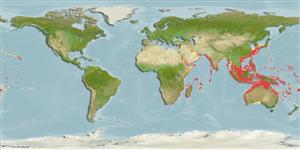
marinhas; estuarina pelagic-neritic; oceanódromo. Tropical; 38°N - 37°S, 22°E - 153°W
Indo-West Pacific: Mossel Bay in South Africa, to the Red Sea and India, possibly to western Pacific (Ref. 3968).
Tamanho / Peso / Idade
Maturidade: Lm ? range ? - ? cm
Max length : 118 cm FL macho/indeterminado; (Ref. 40637); common length : 50.0 cm SL macho/indeterminado; (Ref. 4967); peso máx. Publicado: 10.8 kg (Ref. 40637)
Descrição breve
Chaves de identificação | Morfologia | Morfometria
Espinhos dorsais (total) : 0; Raios dorsais moles (total) : 20 - 27; Espinhos anais: 0; Raios anais moles: 14 - 18.
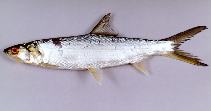
Body shape (shape guide): elongated; Cross section: oval.
Occurs in coastal waters, but enters lagoons and estuaries (Ref. 4832) [actual freshwater records remain to be confirmed]. Benthopelagic (Ref. 58302). Young and adults feed on small fishes and crustaceans (Ref. 5213). Probably spawn at sea, but the transparent larvae migrate to inshore areas and are often found in brackish water (Ref. 7050). Are voracious carnivores that take fish, squid and shrimp bait (Ref. 3968). Edible, but not tasty and full of bones (Ref. 3968). A total length of 126 cm for this species has been reported from Knysna, South Africa (G. Bernardt, pers. comm., e-mail: gerard@smallstreams.com) .
Ciclo de vida e comportamento de acasalamento
Maturidade | Reprodução | Desova | Ovos | Fecundidade | Larvas
Smith, M.M., 1986. Elopidae. p. 155-156. In M.M. Smith and P.C. Heemstra (eds.) Smiths' sea fishes. Springer-Verlag, Berlin. (Ref. 3968)
Categoria na Lista Vermelha da IUCN (Ref. 130435: Version 2025-2 (Global))
Ameaça para o homem
Harmless
Utilização humana
Pescarias: espécies comerciais; peixe desportivo: sim
Ferramentas
Relatórios especiais
Descarregue XML
Fontes da internet
Estimativas baseadas em modelos
Temperatura preferida (Ref.
123201): 20.7 - 28.4, mean 26.9 °C (based on 1366 cells).
Índice de diversidade filogenética (Ref.
82804): PD
50 = 0.5176 [Uniqueness, from 0.5 = low to 2.0 = high].
Bayesian length-weight: a=0.00692 (0.00531 - 0.00902), b=2.99 (2.91 - 3.07), in cm total length, based on LWR estimates for this species (Ref.
93245).
Nível Trófico (Ref.
69278): 4.0 ±0.3 se; based on diet studies.
Vulnerabilidade da pesca (Ref.
59153): Very high vulnerability (79 of 100).
🛈