>
Beryciformes (Sawbellies) >
Melamphaidae (Bigscale fishes or ridgeheads)
Etymology: Melamphaes: Greek, melan, -anos = black + Greek, amphi = both side (Ref. 45335).
Ambiente: milieu / zona climatica / distribuzione batimetrica / gamma di distribuzione
Ecologia
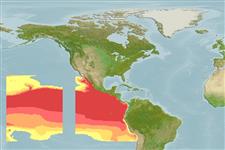
marino batipelagico; distribuzione batimetrica 62 - 500 m (Ref. 51657). Deep-water; 30°N - 23°S, 120°W - 130°W (Ref. 87970)
Eastern Pacific Ocean: tropical, endemic to ETP, from the California coast (ca. 30°N) down to northern Chilean coast (ca. 23°S).
Dimensione / Peso / Età
Maturità: Lm ? range ? - ? cm
Max length : 12.8 cm SL maschio/sesso non determinato; (Ref. 87970)
Breve descrizione
Chiavi di identificazione | Morfologia | Morfometria
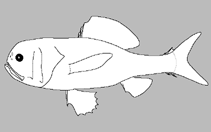
Spine dorsali (totale) : 3; Raggi dorsali molli (totale) : 13 - 16; Spine anali: 1; Raggi anali molli: 8; Vertebre: 27 - 28. The species is characterized by the following: large head (more than 40% of SL, specimens of SL ? 100.0 mm); first gill arch with 20-22 rakers; total vertebrae 26-28, 11 abdominal; haemal arch of the first caudal vertebra is without a spur; D III,13-16; P14-15; ventral fin with 7 soft rays; ventral fin starts before the vertical line of the posterior margin of the pectoral fin basement; anal fin starts under the vertical line of the 3-4 ray of the dorsal fin (posterior end); operculum with 4 scales (Ref. 87970).
Body shape (shape guide): fusiform / normal.
Adults caught below 400-500 meters; juveniles in shallower water (Ref. 51657). Specimens were sampled by open-mouth nets at depth range of 1500-0 m; the minimal sampling depth was 62 m (individuals with SL = 12.7-13.3 mm) (Ref. 87970).
Ciclo vitale e comportamento di accoppiamento
Maturità | Riproduzione | Deposizione | Uova | Fecondità | Larve
Kotlyar, A.N., 2011. Revision of genus Melamphaes (Melamphaidae). II. Multi-raker species: M. polylepis, M. falsidicus sp. nova, M. pachystomus sp. nova, M. macrocephalus, M. leprus. J. Ichthyol. 51(8):658-661. (Ref. 87970)
Stato della Lista Rossa IUCN (Ref. 130435: Version 2025-2 (Global))
Minaccia per l'uomo
Harmless
Usi umani
Strumenti
Rapporti speciali
Scarica XML
Fonti Internet
Stime basate su modelli
Temperatura preferita (Fonte Biblio.
123201): 12.1 - 14.8, mean 13.2 °C (based on 26 cells).
Indice di diversità filogenetica (Fonte Biblio.
82804): PD
50 = 0.5000 [Uniqueness, from 0.5 = low to 2.0 = high].
Bayesian length-weight: a=0.01096 (0.00453 - 0.02656), b=3.09 (2.88 - 3.30), in cm total length, based on LWR estimates for this (Sub)family-body shape (Ref.
93245).
Livello trofico (Fonte Biblio.
69278): 3.7 ±0.2 se; based on size and trophs of closest relatives
Resilienza (Fonte Biblio.
120179): Basso, tempo minimo di raddoppiamento della popolazione 4.5 - 14 anni (Preliminary K or Fecundity.).
Vulnerabilità della pesca (Ref.
59153): Low vulnerability (10 of 100).
🛈