Elasmobranchii (hajar och rockor) (sharks and rays) >
Myliobatiformes (Stingrays) >
Gymnuridae (Butterfly rays)
Etymology: Gymnura: Greek, gymnos = naked + Greek, oura = tail (Ref. 45335).
More on authors: Gilchrist & Thompson.
Miljö: miljö / Klimatzon / djupintervall / distributionsområde
Ekologi
marina bottenlevande; djupintervall 20 - 100 m (Ref. 28016). Subtropical
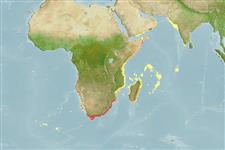
Southeast Atlantic and Western Indian Ocean: Namibia round the Cape to southern Mozambique.
Längd vid första mognad / Storlek / Vikt / Ålder
Könsmognad: Lm ?, range 150 - ? cm
Max length : 250 cm WD hane/ej könsbestämd; (Ref. 3263); publicerad maxvikt: 82.6 kg (Ref. 40637)
Kort beskrivning
Bestämningsnycklar | Morfologi | Morfometri
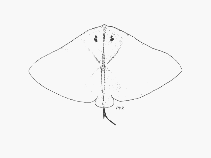
Taggstrålar i ryggfenan (totalt) : 0. Broad diamond-shaped pectoral disc almost twice as wide as it is long; tail shorter than body with black and white bands and a small sting; tentacle at rear edge of each spiracle (Ref. 5578). Grey, green or brown above, often with darker mottling; white below; can change color of upper disc rapidly to match substrate (Ref. 5578).
Body shape (shape guide): other.
Occurs off sandy beaches, muddy estuaries and offshore banks. Found singly or in large groups (Ref. 5578). Feeds on a variety of fishes, crabs and polychaete worms (Ref. 5578). Ovoviviparous (Ref. 50449). Ability to change markings and color to blend into environment (Ref. 3263). Caught by offshore trawlers (Ref. 5578). Caught by shore anglers, it is prized for its strong fight when hooked, often released (Ref. 5578).
Exhibit ovoviparity (aplacental viviparity), with embryos feeding initially on yolk, then receiving additional nourishment from the mother by indirect absorption of uterine fluid enriched with mucus, fat or protein through specialised structures (Ref. 50449). Distinct pairing with embrace (Ref. 205). One year gestation; up to 10 young (Ref. 5578).
Compagno, L.J.V., 1986. Dasyatidae. p. 135-142. In M.M. Smith and P.C. Heemstra (eds.) Smiths' sea fishes. Springer-Verlag, Berlin. (Ref. 3263)
Status på IUCN:s rödlista (Ref. 130435: Version 2025-2 (Global))
Hot mot människor
Harmless
Mänskliga användningsområden
Fiskeri: bycatch; sportfisk: ja
Verktyg
Särskilda rapporter
Ladda ner XML
Internet-källor
Uppskattningar baserade på modeller
Önskad temperatur (Ref.
123201): 14.5 - 27.1, mean 25.3 °C (based on 72 cells).
Index för fylogenetisk mångfald (Ref.
82804): PD
50 = 0.5000 [Uniqueness, from 0.5 = low to 2.0 = high].
Bayesian length-weight: a=0.00851 (0.00393 - 0.01841), b=3.08 (2.88 - 3.28), in cm total length, based on LWR estimates for this (Sub)family-body shape (Ref.
93245).
Trofisk nivå (Ref.
69278): 3.9 ±0.65 se; based on food items.
Resiliens (Ref.
120179): Mycket låg, lägsta populationsfördubblingstid mer än 14 år (Fec=10).
Sårbarhet i fisket (Ref.
59153): Moderate vulnerability (43 of 100).
🛈