Holocephali (chimeren) (chimaeras) >
Chimaeriformes (Chimaeras) >
Chimaeridae (Shortnose chimaeras or ratfishes)
Etymology: Hydrolagus: hydro-, combining form of hydor (Gr.), water; lagos (Gr.), hare, i.e., “water rabbit,” probably referring to three pairs of tooth plates, which tend to protrude from the mouth like a rabbit’s incisors (See ETYFish); macrophthalmus: macro-, from makros (Gr.), long; ophthalmos (Gr.), eye, referring to its large oval eyes (See ETYFish).
Milieu: milieu / Klimaatzone / Diepte / verspreidingsgebied
Ecologie
marien bathydemersaal; diepte 590 - 1160 m (Ref. 97389). Subtropical
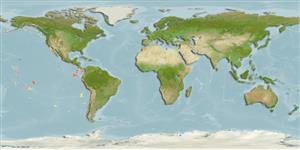
Eastern Pacific: from the central coast of Mexico, Costa Rica, Peru and Chile.
Grootte / Gewicht / Leeftijd
Maturiteit: Lm ? range ? - ? cm
Max length : 63.9 cm TL mannelijk / geslacht onbekend; (Ref. 97389); 58.1 cm TL (female)
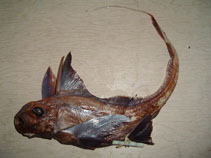
This species is distinguished by the following set of characters: slender body; short and bluntly rounded snout; relatively short head (HDL 24.2-24.5% BDL); relatively large eyes (EYL 30.9-34.2% HDL); oral and preopercular lateral line canals sharing a short common branch from the infraorbital canal; relatively large pectoral fins (P1A 36.5-40.8% BDL), extending posterior to the insertion of pelvic fins; trunk's lateral line canal without sinusoidal undulations; the anterior and posterior regions of second dorsal fin considerably taller than middle region; no anal fin; tail region elongate and slender (PCA 58.3-59.9% BDL); caudal-fin axis horizontal with the fin nearly symmetrical, epaxial and hypaxial lobes equal sized; coloration uniform brown across entire body, no white markings and bluish fins (Ref. 97389).
Body shape (shape guide): elongated; Cross section: angular.
Oviparous (Ref. 205). Eggs are encased in horny shells (Ref. 205).
Levenscyclus en paargedrag
Maturiteit | Voortplanting | Paaien | Eieren | Fecunditeit | Larven
Angulo, A., M.I. López, W.A. Bussing and A. Murase, 2014. Records of chimaeroid fishes (Holocephali: Chimaeriformes) from the Pacific coast of Costa Rica, with the description of a new species of Chimera (Chimaeridae) from the eastern Pacific Ocean. Zootaxa 3861(6):554-574. (Ref. 97389)
Status op de Rode Lijst van het IUCN (Ref. 130435: Version 2025-2 (Global))
Gevaar voor de mens
Harmless
Gebruik door de mens
Tools
Speciale rapporten
Download XML
Internetbronnen
Schattingen op basis van modellen
Fylogenetische diversiteitsindex (Ref.
82804): PD
50 = 0.5000 [Uniqueness, from 0.5 = low to 2.0 = high].
Bayesian length-weight: a=0.00339 (0.00139 - 0.00824), b=3.07 (2.86 - 3.28), in cm total length, based on LWR estimates for this (Sub)family-body shape (Ref.
93245).
Trofisch niveau (Ref.
69278): 3.8 ±0.6 se; based on size and trophs of closest relatives
Weerstandsvermogen (Ref.
120179): laag, minimale populatieverdubbelingstijd 4,5-14 jaar (Assuming Fec <100).
Kwetsbaarheid van de visserij (Ref.
59153): Moderate to high vulnerability (46 of 100).
🛈
Voedingsstoffen (Ref.
124155): Calcium = 38.6 [9.8, 112.6] mg/100g; Iron = 0.933 [0.321, 3.831] mg/100g; Protein = 16.9 [11.3, 20.1] %; Omega3 = 0.325 [0.136, 0.762] g/100g; Selenium = 40.6 [8.9, 111.7] μg/100g; VitaminA = 8.59 [2.78, 25.30] μg/100g; Zinc = 0.599 [0.309, 1.157] mg/100g (wet weight);