Environnement : milieu / zone climatique / profondeur / gamme de distribution
Écologie
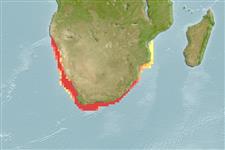
marin démersal; profondeur 10 - 390 m (Ref. 4316). Subtropical; 18°S - 36°S, 12°E - 36°E
Southeast Atlantic and Western Indian Ocean: Cape Fria, Namibia to Maputo, Mozambique. The record of a specimen from Reunion (MHNRUN 36) is probably erroneous (Ref. 33390).
Longueur à la première maturité / Taille / Poids / Âge
Maturité: Lm 32.8, range 27 - 35 cm
Max length : 75.0 cm TL mâle / non sexé; (Ref. 3699); common length : 35.0 cm TL mâle / non sexé; (Ref. 3699); âge max. reporté: 16 années (Ref. 26321)
Description synthétique
Clés d'identification | Morphologie | Morphométrie
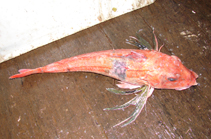
Épines dorsales (Total) : 8 - 9; Rayons mous dorsaux (Total) : 15 - 17; Épines anales: 0; Rayons mous anaux: 14 - 16.
Body shape (shape guide): fusiform / normal.
Found over sandy and muddy bottoms in coastal areas. Feeds on fishes (Ref. 4316) and crustaceans (Ref. 5213). Excellent food fish (Ref. 4316).
Cycle de vie et comportement reproducteur
Maturité | Reproduction | Frai | Œufs | Fécondité | Larves
Richards, W.J. and V.P. Saksena, 1990. Triglidae. p. 680-684. In J.C. Quero, J.C. Hureau, C. Karrer, A. Post and L. Saldanha (eds.) Check-list of the fishes of the eastern tropical Atlantic (CLOFETA). JNICT, Lisbon; SEI, Paris; and UNESCO, Paris. Vol. 2. (Ref. 3687)
Statut dans la liste rouge de l'IUCN (Ref. 130435: Version 2025-2 (Global))
Menace pour l'homme
Harmless
Utilisations par l'homme
Pêcheries: commercial
Outils
Articles particuliers
Télécharger en XML
Sources Internet
Estimations basées sur des modèles
Température préférée (Réf.
123201): 10.3 - 17.9, mean 13.3 °C (based on 65 cells).
Indice de diversité phylogénétique (Réf.
82804): PD
50 = 0.5010 [Uniqueness, from 0.5 = low to 2.0 = high].
Bayesian length-weight: a=0.00912 (0.00425 - 0.01955), b=3.05 (2.87 - 3.23), in cm total length, based on LWR estimates for this (Sub)family-body shape (Ref.
93245).
Niveau trophique (Réf.
69278): 4.1 ±0.3 se; based on diet studies.
Résilience (Réf.
120179): Faible, temps minimum de doublement de population : 4,5 à 14 années (K=0.18; tm=2-5; tmax=16).
Vulnérabilité de la pêche (Ref.
59153): High to very high vulnerability (65 of 100).
🛈
Vulnérabilité climatique (Ref.
125649): Moderate to high vulnerability (48 of 100).
🛈
Nutriments (Ref.
124155): Calcium = 48.1 [26.1, 116.6] mg/100g; Iron = 0.887 [0.473, 1.884] mg/100g; Protein = 19.4 [18.1, 20.7] %; Omega3 = 0.547 [0.256, 1.473] g/100g; Selenium = 41.8 [20.1, 112.1] μg/100g; VitaminA = 12.2 [4.1, 36.7] μg/100g; Zinc = 0.608 [0.429, 0.899] mg/100g (wet weight);