>
Eupercaria/misc (Various families in series Eupercaria) >
Labridae (Wrasses) > Hypsigenyinae
Etymology: Choerodon: Greek, choiros = a pig + odous = teeth (Ref. 45335); referrring to the prominent anterior canines of the species in this genus (Ref. 116605).
More on author: Bloch.
Miljö: miljö / Klimatzon / djupintervall / distributionsområde
Ekologi
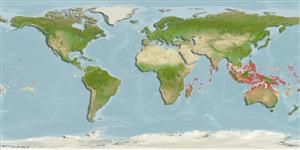
marina revassocierade; djupintervall 1 - 25 m (Ref. 90102). Tropical; 15°N - 30°S
Indo-West Pacific: Sri Lanka eastward to French Polynesia, north to the Ryukyu Islands, south to New Caledonia.
Längd vid första mognad / Storlek / Vikt / Ålder
Könsmognad: Lm ?, range 23 - ? cm
Max length : 50.0 cm TL hane/ej könsbestämd; (Ref. 90102)
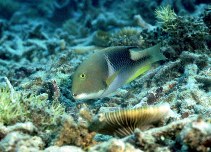
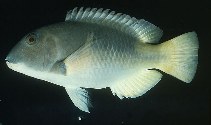
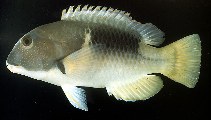
Taggstrålar i ryggfenan (totalt) : 12 - 13; Mjukstrålar i ryggfenan (totalt) : 7; Taggstrålar i analfenan: 3; Mjukstrålar i analfenan: 9. This species is distinguished by the following characters: body deep, its depth 2.4-2.7 times in standard length; dorsal profile of head convexly curved above eyes; anterior tip of head forming a broad angle with snout steeply inclined; jaws prominent; 4 strong canines situated anteriorly in each jaw with second pair in lower jaw directed laterally; an enlarged canine present on each side at rear of upper jaw; D XIII,7, continuous with spines and anterior soft rays of similar length; A III,9; pectoral fins with ii unbranched and 13-14 branched rays; pelvic fins not filamentous; caudal fin truncate to slightly rounded; lateral line continuous, smoothly curved, with 29 pored scales; scales barely reaching onto bases of dorsal and anal fins; scales in front of dorsal fin distinctly not extending forward to above eye; cheek and opercle scaly, scales on preopercle small, less than 1/4 the size of those on body; lower jaw without scales. Colour of body greenish to grey with underside of head, chest and lower portion of sides white or bluish; a wedge-shaped white band extending upward onto back behind pectoral fins; a large rectangular white saddle situated dorsally on caudal peduncle extending forward below rear of dorsal fin; head speckled with orange; pectoral-fin base covered by a large blue to black spot; dorsal fin greenish grey anteriorly and yellowish posteriorly; caudal fin greenish orange; anal fin yellow with orange markings; a narrow blue margin on dorsal and anal fins. Small individuals overall greenish grey with several whitish bars (Ref. 9823).
Body shape (shape guide): fusiform / normal; Cross section: oval.
Adults inhabit reef flats and lagoon reefs, in areas with seagrass or mixed sand, rubble, and coral (Ref. 9710). They often form small aggregations (Ref. 8631). Juveniles occur inshore and usually form small groups in estuarine seagrass beds. Adults can be found in inner as well as outer reefs and are territorial (Ref. 48636). Feed mainly on hard-shelled prey including crustaceans, mollusks and sea urchins. Oviparous, distinct pairing during breeding (Ref. 205). In Hong Kong live fish markets (Ref. 27253).
Livscykel och parningsbeteende
Könsmognad | Reproduktion | Lek | Ägg | Fekunditet | Larver
Oviparous, distinct pairing during breeding (Ref. 205).
Westneat, M.W., 2001. Labridae. Wrasses, hogfishes, razorfishes, corises, tuskfishes. p. 3381-3467. In K.E. Carpenter and V. Niem (eds.) FAO species identification guide for fishery purposes. The living marine resources of the Western Central Pacific. Vol. 6. Bony fishes part 4 (Labridae to Latimeriidae), estuarine crocodiles. FAO, Rome. (Ref. 9823)
Status på IUCN:s rödlista (Ref. 130435: Version 2025-2 (Global))
Hot mot människor
Harmless
Mänskliga användningsområden
Fiskeri: kommersiell; Akvarium: Kommersiell
Verktyg
Särskilda rapporter
Ladda ner XML
Internet-källor
Uppskattningar baserade på modeller
Önskad temperatur (Ref.
123201): 26.7 - 29.3, mean 28.6 °C (based on 2547 cells).
Index för fylogenetisk mångfald (Ref.
82804): PD
50 = 0.5000 [Uniqueness, from 0.5 = low to 2.0 = high].
Bayesian length-weight: a=0.01445 (0.00896 - 0.02332), b=3.13 (2.99 - 3.27), in cm total length, based on LWR estimates for this species & (Sub)family-body (Ref.
93245).
Trofisk nivå (Ref.
69278): 4.2 ±0.3 se; based on diet studies.
Resiliens (Ref.
120179): Mellan, lägsta populationsfördubblingstid 1,4-4,4 år (Preliminary K or Fecundity.).
Sårbarhet i fisket (Ref.
59153): Moderate vulnerability (40 of 100).
🛈
Näringsämnen (Ref.
124155): Calcium = 36.7 [22.3, 62.5] mg/100g; Iron = 0.507 [0.289, 0.911] mg/100g; Protein = 18.9 [16.1, 21.1] %; Omega3 = 0.134 [0.088, 0.206] g/100g; Selenium = 27.6 [16.3, 50.5] μg/100g; VitaminA = 104 [31, 374] μg/100g; Zinc = 1.09 [0.76, 1.66] mg/100g (wet weight);