>
Ovalentaria/misc (Various families in series Ovalentaria) >
Pomacentridae (Damselfishes) > Pomacentrinae
Etymology: Chrysiptera: Greek, chrysos = golden + Greek, pteron = fin, wing (Ref. 45335); rollandi: Named for Mr. Jean Rolland (R.Bajol, pers.comm. 06/16).
Eponymy: Jean Rolland (1933–2018) was a highly skilled welder by trade. [...] (Ref. 128868), visit book page.
More on author: Whitley.
Окружающая среда: среда / климатическая зона / пределы глубины / диапазон распространения
экология
морской ассоциированный с рифами; немигрирующий; пределы глубины 2 - 35 m (Ref. 7247). Tropical; 20°N - 23°S
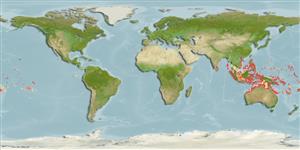
Eastern Indian Ocean and Western Pacific: Andaman Sea to the Loyalty Islands, north to the Philippines, south to the Great Barrier Reef and New Caledonia. Recently recorded from Tonga (Ref. 53797).
Размер / Вес / Возраст
половая зрелость: Lm ? range ? - ? cm
Max length : 7.5 cm TL самец/пол неопределен; (Ref. 48636)
Краткое описание
определительные ключи | морфология | морфометрия
колючие лучи спинного плавника (общее число) : 13; членистые (мягкие) лучи спинного плавника (общее число) : 10 - 11; колючие лучи анального плавника: 2; членистые (мягкие) лучи анального плавника: 12 - 13.
Body shape (shape guide): fusiform / normal; Cross section: compressed.
Adults occur singly or in small groups in lagoons, harbors, and outer reef slopes. Found among corals and coral rubble (Ref. 9710). Feed mainly on zooplankton. Oviparous, distinct pairing during breeding (Ref. 205). Eggs are demersal and adhere to the substrate (Ref. 205). Males guard and aerate the eggs (Ref. 205). DNA analysis suggests that this species could be divided to three species at least, i.e. fish from (1) Andaman Sea, (2) Indo-Australian archipelago, and (3) New Caledonia and southern Coral Sea are distinct species. Diurnal species (Ref. 54980; 113699).
Жизненный цикл и брачное поведение
половая зрелость | размножение | нерест | икра | Плодовитость | личинки
Oviparous, distinct pairing during breeding (Ref. 205). Eggs are demersal and adhere to the substrate (Ref. 205). Males guard and aerate the eggs (Ref. 205).
Allen, G.R., 1991. Damselfishes of the world. Mergus Publishers, Melle, Germany. 271 p. (Ref. 7247)
Статус Красного Списка МСОП (Ref. 130435: Version 2025-2 (Global))
Угроза для людей
Harmless
Использование человеком
рыболовство: интереса не представляет; аквариум: коммерческий
дополнительная информация
инструменты
Специальные отчеты
Скачать в формате XML
ресурсы в Интернет
Оценки, основанные на моделях
Предпочтительная температура (ссылка
123201): 25.7 - 29.3, mean 28.6 °C (based on 2147 cells).
Индекс филогенетического разнообразия (ссылка
82804): PD
50 = 0.5000 [Uniqueness, from 0.5 = low to 2.0 = high].
Bayesian length-weight: a=0.01445 (0.00624 - 0.03346), b=3.00 (2.81 - 3.19), in cm total length, based on LWR estimates for this (Sub)family-body shape (Ref.
93245).
Трофический уровень (ссылка
69278): 2.7 ±0.30 se; based on food items.
устойчивость к внешним воздействиям (ссылка
120179): высокий, минимальное время удвоения популяции до 15 месяцев (Preliminary K or Fecundity.).
Уязвимость рыбной ловли (Ref.
59153): Low vulnerability (10 of 100).
🛈
Питательные вещества (Ref.
124155): Calcium = 150 [84, 257] mg/100g; Iron = 0.95 [0.59, 1.49] mg/100g; Protein = 18.5 [17.5, 19.5] %; Omega3 = 0.162 [0.099, 0.256] g/100g; Selenium = 23.6 [13.4, 42.8] μg/100g; VitaminA = 138 [48, 403] μg/100g; Zinc = 2.37 [1.64, 3.27] mg/100g (wet weight);