>
Cypriniformes (Carps) >
Nemacheilidae (Brook loaches)
Etymology: Paraschistura: Generic name taken from its similarity with the genus Schistura.
Milieu: milieu / Klimaatzone / Diepte / verspreidingsgebied
Ecologie
; zoet water benthopelagisch. Subtropical
Asia: Iran and Pakistan. Records of this species from the Helmand basin in Afghanistan refer to Paraschistura alta.
Grootte / Gewicht / Leeftijd
Maturiteit: Lm ? range ? - ? cm
Max length : 6.7 cm TL mannelijk / geslacht onbekend; (Ref. 125884); max. gepubliceerd gewicht: 3.28 g (Ref. 125884)
Korte beschrijving
Determinatiesleutels | Morfologie | Morfometrie
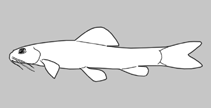
Paraschistura bampurensis is distinguished from its congeners in Iran and adjacent Pakistan by a combination of non-unique characters. It differs from P. kessleri, P. turcmenica and P. lindbergi from adjacent Pakistan by having the flank and back covered by scales (vs. without scales) and by the presence of a suborbital flap in males (vs. absence); P. cristata by the absence of a dorsal adipose crest and procurrent caudal-fin rays on the caudal peduncle (vs. presence); from P. cristata, P. nielseni and P. turcmenica by having a suborbital flap in males (vs. a suborbital groove in P. nielseni, no suborbital flap or groove in P. cristata and P. turcmenica), a pointed snout (vs. obtuse in P. nielseni and P. cristata) and a color pattern consisting of 11-18 dark-brown bars on the flank usually narrower than interspaces, especially on the caudal peduncle (vs. 6-11 bars, absent or very faint on the flank in front of the dorsal-fin origin in P. nielseni). Additional characters useful to identify P. bampurensis include the following: lateral line incomplete, usually reaching beyond dorsal-fin base, beyond anal-fin origin in some individuals; caudal fin forked or deeply emarginate; black spot at the base of first dorsal-fin rays bold; dorsal fin usually with 8 ½ branched rays; pelvic fin reaching to about 1-2 eye diameter in front of anus (Ref. 103390).
Body shape (shape guide): elongated.
Levenscyclus en paargedrag
Maturiteit | Voortplanting | Paaien | Eieren | Fecunditeit | Larven
Freyhof, J., G. Sayyadzadeh, H.R. Esmaeili and M. Geiger, 2015. Review of the genus Paraschistura from Iran with description of six new species (Teleostei: Nemacheilidae). Ichthyol. Explor. Freshwat. 26(1):1-48. (Ref. 103390)
Status op de Rode Lijst van het IUCN (Ref. 130435: Version 2025-2 (Global))
Gevaar voor de mens
Harmless
Gebruik door de mens
Tools
Speciale rapporten
Download XML
Internetbronnen
Schattingen op basis van modellen
Fylogenetische diversiteitsindex (Ref.
82804): PD
50 = 0.5000 [Uniqueness, from 0.5 = low to 2.0 = high].
Bayesian length-weight: a=0.00741 (0.00449 - 0.01223), b=3.14 (3.00 - 3.28), in cm total length, based on LWR estimates for this species & Genus-body shape (Ref.
93245).
Trofisch niveau (Ref.
69278): 2.8 ±0.3 se; based on size and trophs of closest relatives
Weerstandsvermogen (Ref.
120179): Gemiddeld, minimale populatieverdubbelingstijd 1,4-4,4 jaar (Preliminary K or Fecundity.).
Kwetsbaarheid van de visserij (Ref.
59153): Low vulnerability (10 of 100).
🛈