>
Kurtiformes (Nurseryfishes, cardinalfishes.) >
Apogonidae (Cardinalfishes) > Apogoninae
Etymology: Cheilodipterus: Greek, cheilos = lip + Greek, di = two + Greek, pteryx = fin (Ref. 45335).
More on author: Cuvier.
Environnement : milieu / zone climatique / profondeur / gamme de distribution
Écologie
marin récifal; profondeur 0 - 40 m (Ref. 9710). Tropical; 30°N - 32°S
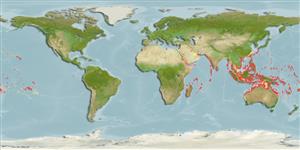
Indo-Pacific: Red Sea to Mozambique (Ref. 4329) and eastward to the Pitcairn Group, north to southern Japan, south to Lord Howe Island and Rapa.
Taille / Poids / Âge
Maturité: Lm ? range ? - ? cm
Max length : 13.0 cm TL mâle / non sexé; (Ref. 2158)
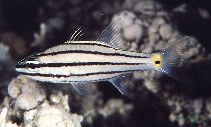
Épines dorsales (Total) : 7; Rayons mous dorsaux (Total) : 9; Épines anales: 2; Rayons mous anaux: 8. Characterized by having dorsal fin rays VI-I, 9; anal fin rays II,8; pectoral fin rays 12; pelvic fin rays I, 5; pored lateral line scales 24-25; predorsal scales 6; circumpeduncular scales 12; large canine-like teeth on jaws; serrated preopercular margin; characterized further by pale grey color to whitish with five narrow black stripes; base of caudal fin yellow; greatest depth of body 3.1-3.7 in SL (Ref. 90102).
Body shape (shape guide): fusiform / normal; Cross section: oval.
Inhabits reef flats and lagoon and seaward reefs to a depth of 40 m or more. Occurs singly or in small to large aggregations, taking shelter in dark crevices, branched coral, under ledges, and among the spines of Diadema setosum. Nocturnal species (Ref. 7300). Feeds on small crustaceans and gastropods, also on small fishes. Generally common (Ref. 9710). Has been reared in captivity (Ref. 35404).
Cycle de vie et comportement reproducteur
Maturité | Reproduction | Frai | Œufs | Fécondité | Larves
Mouthbrooders (Ref. 240). Distinct pairing during courtship and spawning (Ref. 205).
Gon, O., 1993. Revision of the cardinalfish genus Cheilodipterus (Perciformes: Apogonidae), with description of five new species. Indo-Pac. Fish. (22):59 p. (Ref. 8525)
Statut dans la liste rouge de l'IUCN (Ref. 130435: Version 2025-2 (Global))
Menace pour l'homme
Harmless
Utilisations par l'homme
Pêcheries: intérêt commercial mineur; Aquarium: Aquariums publics
Outils
Articles particuliers
Télécharger en XML
Sources Internet
Estimations basées sur des modèles
Température préférée (Réf.
123201): 24.9 - 29, mean 27.9 °C (based on 828 cells).
Indice de diversité phylogénétique (Réf.
82804): PD
50 = 0.5000 [Uniqueness, from 0.5 = low to 2.0 = high].
Bayesian length-weight: a=0.01000 (0.00628 - 0.01592), b=3.05 (2.92 - 3.18), in cm total length, based on LWR estimates for this species & (Sub)family-body (Ref.
93245).
Niveau trophique (Réf.
69278): 3.9 ±0.4 se; based on diet studies.
Résilience (Réf.
120179): Haut, temps minimum de doublement de population inférieur à 15 mois (Preliminary K or Fecundity.).
Vulnérabilité de la pêche (Ref.
59153): Low vulnerability (10 of 100).
🛈
Nutriments (Ref.
124155): Calcium = 129 [69, 223] mg/100g; Iron = 0.828 [0.481, 1.388] mg/100g; Protein = 18.8 [17.6, 19.8] %; Omega3 = 0.111 [0.064, 0.197] g/100g; Selenium = 32.5 [15.7, 67.9] μg/100g; VitaminA = 90.6 [30.6, 264.8] μg/100g; Zinc = 1.63 [1.07, 2.40] mg/100g (wet weight);