>
Clupeiformes (Herrings) >
Engraulidae (Anchovies) > Engraulinae
Etymology: Cetengraulis: Greek, ketos = a marine monster, whale + Greek, eggraulis, -eos = anchovy (Ref. 45335).
More on author: Günther.
Environnement : milieu / zone climatique / profondeur / gamme de distribution
Écologie
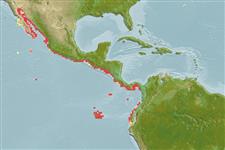
marin; saumâtre pelagic-neritic; non migrateur; profondeur 0 - 32 m (Ref. 96339). Subtropical; 32°N - 4°S, 115°W - 78°W (Ref. 54323)
Eastern Pacific: southwestern coast of Baja California, Mexico and from the Gulf of California to northern Peru (up to the Bay of Sechura). Apparently reaching Los Angeles, USA, but these are perhaps releases from tuna boats.
Longueur à la première maturité / Taille / Poids / Âge
Maturité: Lm 12.9, range 12 - ? cm
Max length : 22.0 cm TL mâle / non sexé; (Ref. 96339); common length : 12.0 cm SL mâle / non sexé; (Ref. 9298); âge max. reporté: 3 années (Ref. 905)
Description synthétique
Clés d'identification | Morphologie | Morphométrie
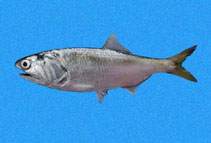
Épines dorsales (Total) : 0; Épines anales: 0; Rayons mous anaux: 17 - 24. Head large and deep. Snout short and pointed, about 2/3 eye diameter; maxilla moderate, tip blunt, just failing to reach lower jaw articulation; lower gill rakers fine and numerous, increasing in large fishes; no gill rakers on posterior face of third epibranchial. Branchiostegal rays 8, long and slender; branchiostegal membrane broad. Silver stripe disappearing at about 8-10 cm SL.
Body shape (shape guide): fusiform / normal; Cross section: compressed.
Occurs inshore, principally over mud flats and forming quite large schools. Apparently not making long migrations along sandy or rocky areas. Juveniles feed principally on diatoms, also silico-flagellates, dinoflagellates and small crustaceans; adults also mainly on benthic diatoms. Used as tuna baitfish. Processed into fishmeal and oil.
Whitehead, P.J.P., G.J. Nelson and T. Wongratana, 1988. FAO Species Catalogue. Vol. 7. Clupeoid fishes of the world (Suborder Clupeoidei). An annotated and illustrated catalogue of the herrings, sardines, pilchards, sprats, shads, anchovies and wolf-herrings. FAO Fish. Synop. 125(7/2):305-579. Rome: FAO. (Ref. 189)
Statut dans la liste rouge de l'IUCN (Ref. 130435: Version 2025-2 (Global))
Menace pour l'homme
Harmless
Utilisations par l'homme
Pêcheries: hautement commercial; appât: usually
Outils
Articles particuliers
Télécharger en XML
Sources Internet
Estimations basées sur des modèles
Température préférée (Réf.
123201): 22.3 - 29.1, mean 25.9 °C (based on 231 cells).
Indice de diversité phylogénétique (Réf.
82804): PD
50 = 0.7500 [Uniqueness, from 0.5 = low to 2.0 = high].
Bayesian length-weight: a=0.00525 (0.00314 - 0.00878), b=3.26 (3.11 - 3.41), in cm total length, based on LWR estimates for this species & (Sub)family-body (Ref.
93245).
Niveau trophique (Réf.
69278): 2.5 ±0.21 se; based on food items.
Résilience (Réf.
120179): Haut, temps minimum de doublement de population inférieur à 15 mois (K=0.9-2.6; tm=1; tmax=4).
Prior r = 0.96, 95% CL = 0.64 - 1.44, Based on 3 data-limited stock assessments.
Vulnérabilité de la pêche (Ref.
59153): Low vulnerability (19 of 100).
🛈
Vulnérabilité climatique (Ref.
125649): Moderate vulnerability (40 of 100).
🛈
Nutriments (Ref.
124155): Calcium = 176 [104, 434] mg/100g; Iron = 2.28 [1.19, 4.07] mg/100g; Protein = 19.6 [18.1, 21.1] %; Omega3 = 0.642 [0.347, 1.276] g/100g; Selenium = 23.1 [10.8, 49.1] μg/100g; VitaminA = 5.29 [1.40, 16.98] μg/100g; Zinc = 1.63 [1.12, 2.52] mg/100g (wet weight);