Umwelt: Milieu / Klimazone / Tiefenbereich / Verbreitungsgebiet
Ökologie
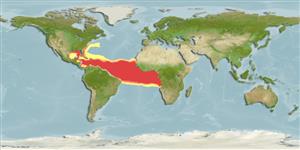
seewasser bathypelagisch; standorttreu; tiefenbereich 200 - 777 m (Ref. 3587). Deep-water; 39°N - 15°S, 98°W - 14°E (Ref. 1371)
Atlantic Ocean: US coast and in the Gulf of Mexico and Caribbean in the western Atlantic; from the Gulf of Guinea (Ivory to Angola), in the eastern Atlantic.
Größe / Gewicht / Alter
Geschlechtsreife: Lm ? range ? - ? cm
Max length : 50.0 cm TL Männchen/unbestimmt; (Ref. 1371)
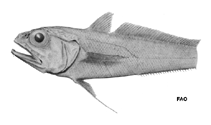
Rückenflossenstacheln (insgesamt) : 0; Afterflossenstacheln: 0. Head large, rather firm, not cavernous. Eyes are relatively large. Chin barbels rudimentary. Integument thick, scale pocket usually well defined. Pyloric caeca 30 to 40.
Body shape (shape guide): elongated; Cross section: oval.
Lebenszyklus und Paarungsverhalten
Geschlechtsreife | Fortpflanzung | Ablaichen | Eier | Fruchtbarkeit | Larven
Cohen, D.M., T. Inada, T. Iwamoto and N. Scialabba, 1990. FAO species catalogue. Vol. 10. Gadiform fishes of the world (Order Gadiformes). An annotated and illustrated catalogue of cods, hakes, grenadiers and other gadiform fishes known to date. FAO Fish. Synop. 125(10). Rome: FAO. 442 p. (Ref. 1371)
IUCN Rote Liste Status (Ref. 130435: Version 2025-2 (Global))
Bedrohung für Menschen
Harmless
Nutzung durch Menschen
Fischereien: kleinfischerei
Tools
Zusatzinformationen
Download XML
Internet Quellen
Schätzungen auf der Grundlage von Modellen
Bevorzugte Temperatur (Ref.
123201): 8.7 - 18.4, mean 11.4 °C (based on 107 cells).
Phylogenetischer Diversitätsindex (Ref.
82804): PD
50 = 0.5001 [Uniqueness, from 0.5 = low to 2.0 = high].
Bayesian length-weight: a=0.00372 (0.00143 - 0.00967), b=3.11 (2.88 - 3.34), in cm total length, based on LWR estimates for this (Sub)family-body shape (Ref.
93245).
Trophische Ebene (Ref.
69278): 3.2 ±0.3 se; based on size and trophs of closest relatives
Anfälligkeit der Fischerei (Ref.
59153): Moderate vulnerability (40 of 100).
🛈